WhatsApp Business API Pricing in India: Rates and BSP Comparison
WhatsApp Business API pricing depends on the type of message you send, the country of the recipient and your monthly volume. This guide sets out the four message categories, the India rate card, how to estimate a monthly bill, and what to compare when you pick a Business Solution Provider (BSP).
How WhatsApp Business API pricing works
Meta charges per delivered message, not per message sent. The rate depends on the recipient’s market, the currency and the message category. There are four categories:
- Marketing: offers, promotions, product suggestions, abandoned cart reminders and retargeting.
- Utility: order confirmations and other operational updates.
- Authentication: one-time codes and account logins.
- Service: replies that support a customer, such as product availability or event reminders.
Incoming messages from users are free, and Meta does not charge for service messages or for utility messages sent in reply to a user. Utility and authentication messages have volume tiers, so the per-message rate drops as you send more. A tier’s rate applies only to the messages inside that tier.
India rate card
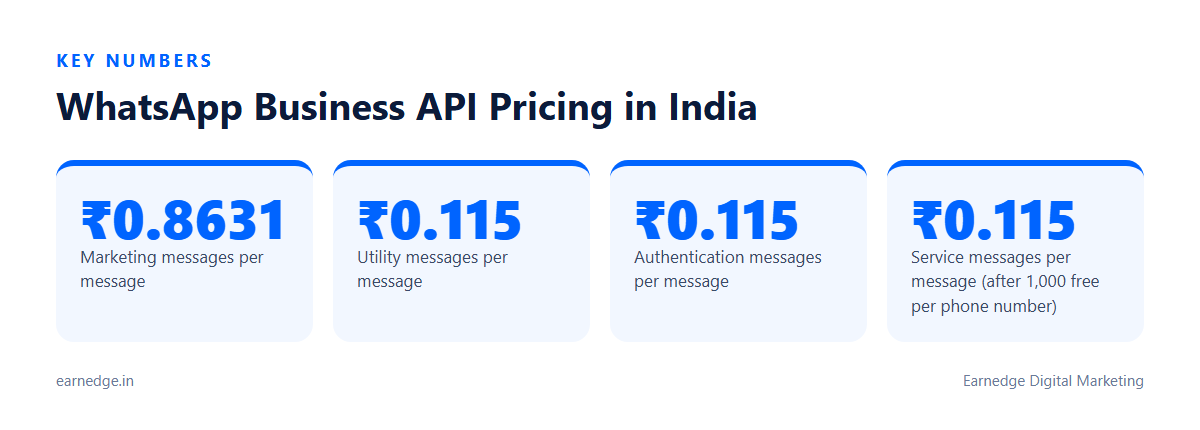
For India, the rate card effective October 1, 2026 lists marketing messages at ₹0.8631 each, and utility and authentication messages at ₹0.115 each. Third-party summaries of the card disagree on how service messages are billed, so confirm that line on Meta’s official rate card before you budget. Meta updates the rates quarterly.
These are Meta’s charges only. Your BSP adds its own platform fee on top, and some Indian BSPs add 10 to 30% to Meta’s rates, which becomes a large amount at scale.
Estimating your monthly cost
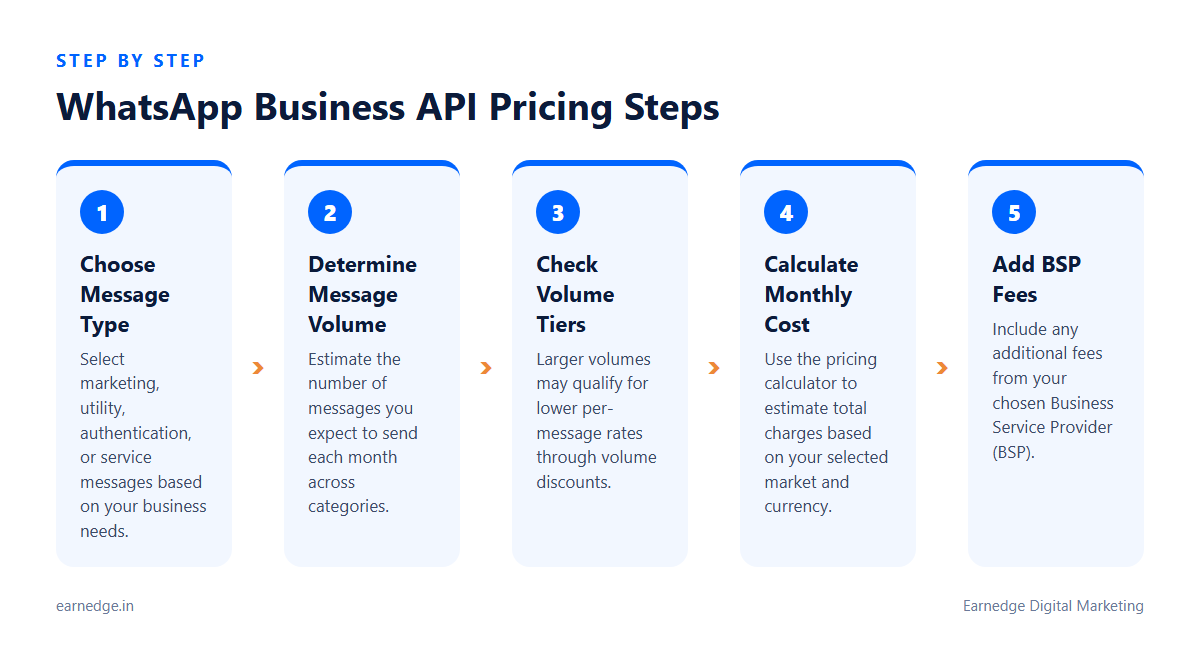
Multiply the messages you expect to send in each category by the rate for that category, then add your BSP’s fee. As an example, 10,000 marketing messages cost 10,000 × ₹0.8631 = ₹8,631, and 10,000 utility messages cost 10,000 × ₹0.115 = ₹1,150, before BSP fees and GST. Meta’s pricing calculator does the same sum for a selected market, currency and category.
Marketing messages are always billed, so they usually decide the size of the bill. If you plan to send promotions at volume, the guide to WhatsApp marketing messages covers what to send and how to keep customers engaged.
Indian BSPs compared
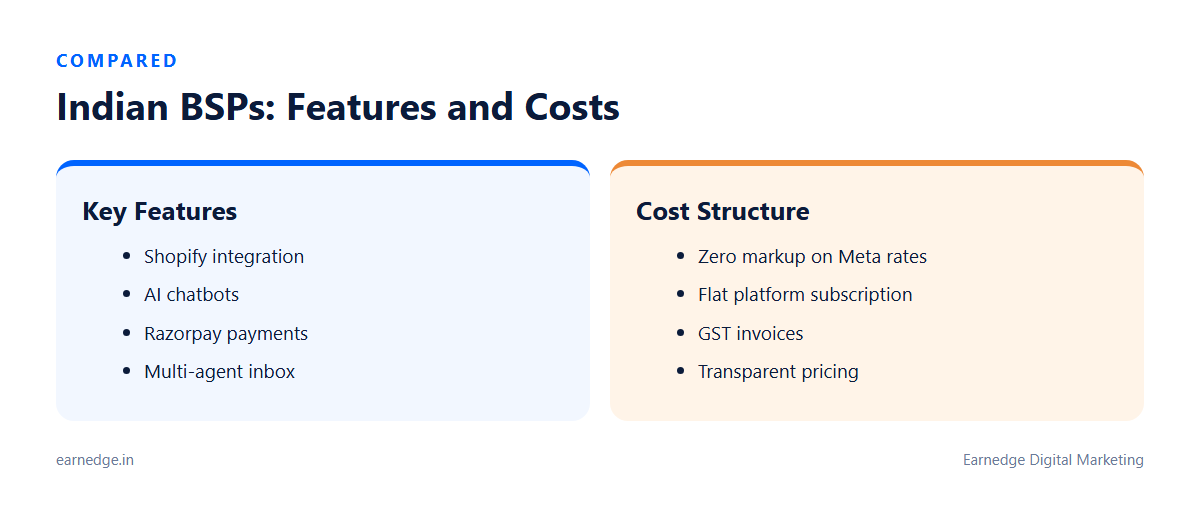
Look for a BSP that passes through Meta’s rates and charges a transparent platform fee. Ask for per-message rates in writing before you sign up, and check dashboard usability, onboarding and integrations with the tools you already use. Businesses on the regular GST scheme (not composition) can reclaim input GST.
- AiSensy is a Delhi-based BSP for Indian small and mid-sized businesses. It is strong in direct-to-consumer and retail and integrates with Shopify.
- Wati operates globally with a strong presence in India. It has a clean interface and CRM integrations, but tier limits on seats and chatbot sessions can limit scale.
- Gupshup is India’s largest BSP by volume and serves enterprise senders. It offers custom pricing and requires minimum monthly commitments.
- Interakt is India-focused and was acquired by Jio Haptik. It integrates with Shopify, which suits e-commerce.
- Whautomate is a Singapore-based Meta Tech Partner. By its own description, it passes Meta’s per-message rates through without markup and charges a flat subscription. It lists Shopify integration, Razorpay payments, AI chatbots, appointment booking and a shared team inbox.
Enterprise-focused providers such as Gupshup make more sense once your volume is high.