

Review & Reputation Management Guide
What Is Review & Reputation Management?
Review and reputation management is the process of collecting genuine customer reviews, responding to feedback, monitoring brand mentions, and maintaining a positive online reputation across platforms such as Google Business Profile, Facebook, Yelp, and industry-specific directories. A strong reputation improves customer trust, local SEO performance, and conversion rates.
Review & Reputation Management: The Complete Guide to Building Trust and Improving Local SEO (2026)
Customers trust other customers more than advertisements.
Before calling your business, booking an appointment, or requesting a quote, most people check your Google reviews. A strong review profile builds confidence, improves click-through rates, and increases conversions. It also helps Google understand that your business is active, trusted, and relevant within your local market.
Review and reputation management is no longer just a customer service task. It is a critical component of local SEO, Google Maps visibility, and AI-powered search.
This guide explains how to build a sustainable review strategy, respond professionally to customer feedback, monitor your online reputation, and use reviews to strengthen your local search presence.
If you are building a complete local SEO strategy, start with our Local SEO Services page and What Is Local SEO? The Complete Guide (2026) before implementing the recommendations in this article.
Table of Contents
- Why Reviews Matter
- How Reviews Impact Local SEO
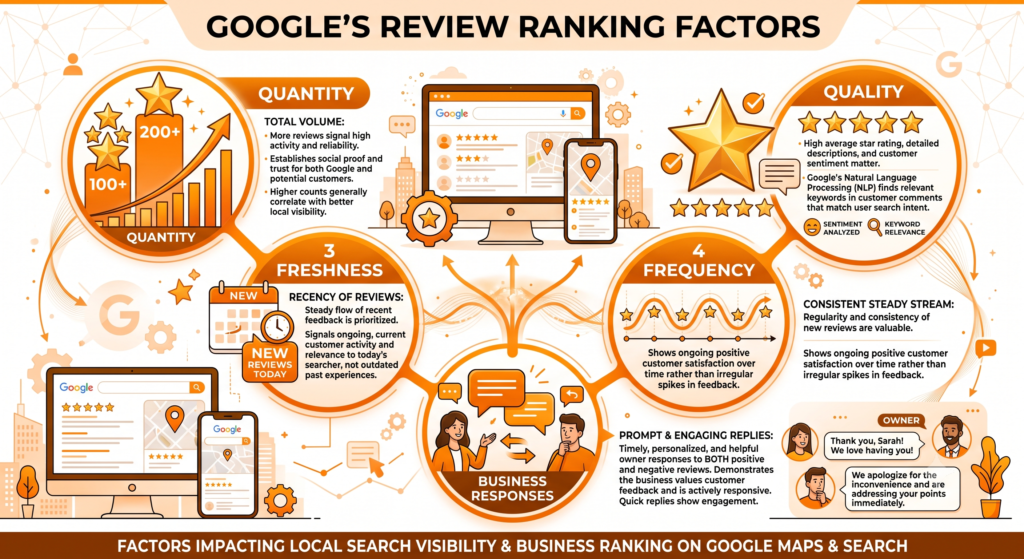
- Google Review Ranking Factors
- How to Get More Reviews
- How to Respond to Reviews
- Managing Negative Reviews
- Reputation Monitoring
- Common Mistakes
- Review Management Checklist
- Frequently Asked Questions

Why Reviews Matter
Online reviews influence two important audiences:
- Potential customers
- Search engines
For customers, reviews provide social proof that your business delivers quality products or services.
For Google, reviews indicate that your business is active, trustworthy, and serving real customers.
Benefits of strong review management include:
- Higher Google Maps visibility
- Increased customer trust
- More website visits
- Higher click-through rates
- Better conversion rates
- Improved brand reputation
- More repeat customers
Businesses with a consistent flow of positive reviews often outperform competitors with outdated or inactive profiles.
How Reviews Impact Local SEO
Reviews are one of the strongest trust signals in local search.
Google evaluates several review-related factors when determining local rankings.
These include:
- Review quantity
- Review quality
- Review freshness
- Review frequency
- Review diversity
- Business owner responses
Reviews also help Google better understand the products and services your business offers because customers naturally mention them in their feedback.
For example:
“EarnEdge helped improve our Google Business Profile and Local SEO rankings.”
This review reinforces your expertise in both services without adding keywords yourself.
Google Review Ranking Factors
Google does not rank businesses simply because they have the highest rating.
Instead, it considers multiple quality signals.
Review Quantity
Businesses with more genuine reviews generally have stronger trust signals.
Focus on collecting reviews consistently rather than trying to generate a large number all at once.
Review Quality
Detailed reviews are often more valuable than short comments.
A useful review usually explains:
- What service was provided
- The customer’s experience
- The results achieved
These reviews help future customers make informed decisions.
Review Freshness
Recent reviews demonstrate that your business remains active.
A business with steady monthly reviews often appears more trustworthy than one with hundreds of reviews that are several years old.
Owner Responses
Responding to reviews shows that you value customer feedback.
Professional responses also encourage future customers to engage with your business.
How to Get More Google Reviews
Many businesses wait for customers to leave reviews voluntarily.
Successful businesses make review generation part of their customer experience.
Ask at the Right Time
The best time to request a review is immediately after delivering a successful outcome.
Examples include:
- Completing a project
- Finishing an installation
- Delivering a service
- Receiving positive verbal feedback
Customers are most likely to leave reviews while the experience is still fresh.
Make the Process Simple
Reduce friction by providing:
- A direct Google review link
- A QR code
- Email follow-up
- SMS reminder
The fewer steps involved, the higher the completion rate.
Train Your Team
Every customer-facing employee should understand when and how to ask for reviews politely.
Consistency across your team creates a steady flow of authentic feedback.
Never Buy Reviews
Avoid:
- Paying for reviews
- Offering incentives
- Posting fake reviews
- Asking employees to leave reviews
These practices violate platform policies and can damage your business reputation.
How to Respond to Reviews
Responding to reviews demonstrates professionalism and appreciation.
Aim to reply to every review within a few days.
Positive Review Example
Thank you for your kind feedback. We are glad our Local SEO services helped improve your online visibility. We appreciate your support and look forward to working with you again.
Neutral Review Example
Thank you for sharing your experience. We appreciate your feedback and will continue improving our services.
Negative Review Example
Thank you for bringing this issue to our attention. We value your feedback and would like the opportunity to resolve your concerns. Please contact us directly so we can assist you.
Remain respectful, avoid arguments, and never disclose customer information.
Managing Negative Reviews
Negative reviews are not always harmful.
A balanced review profile appears more authentic than a profile containing only perfect ratings.
When responding to criticism:
- Acknowledge the concern.
- Apologize when appropriate.
- Offer a solution.
- Move the conversation offline.
- Follow up after resolution.
Professional responses often impress potential customers more than the original review.
Reputation Monitoring
Google reviews are only one part of your online reputation.
Monitor mentions across:
- Google Business Profile
- Yelp
- Bing Places
- Industry directories
- Local business directories
- Social media platforms
Regular monitoring helps identify issues before they become larger reputation problems.
Connect Reviews with Your Local SEO Strategy
Reviews work best when combined with other local SEO activities.
Your complete strategy should include:
- Google Business Profile Optimization to improve local visibility.
- Local Keyword Research to target customer search intent.
- Local Citation Management to maintain accurate business information.
- Local SEO Reporting to measure performance over time.
Together, these elements strengthen your authority in Google’s local search ecosystem.
Common Review & Reputation Management Mistakes
Avoid these common mistakes:
- Ignoring customer reviews
- Responding emotionally to criticism
- Buying fake reviews
- Asking every customer at the same stage regardless of satisfaction
- Leaving negative reviews unanswered
- Removing legitimate criticism instead of resolving it
- Focusing only on Google while ignoring other review platforms
Long-term reputation is built through consistency and transparency.
Review & Reputation Management Checklist
Use this checklist to strengthen your online reputation.
✅ Claim and verify your Google Business Profile
✅ Create a review request process
✅ Ask customers after successful interactions
✅ Provide a direct review link
✅ Respond to every review
✅ Monitor multiple review platforms
✅ Address negative feedback professionally
✅ Track review growth each month
✅ Share positive reviews on your website and social media
✅ Continue improving customer experience
Frequently Asked Questions
How many Google reviews do I need?
There is no ideal number. The goal is to maintain a consistent flow of genuine reviews rather than reaching a specific total.
Do reviews improve Google Maps rankings?
Yes. Reviews contribute to Google’s understanding of your business’s trustworthiness and relevance, making them an important local ranking signal.
Should I respond to every review?
Yes. Responding to both positive and negative reviews demonstrates professionalism and shows customers that you value their feedback.
Can fake reviews hurt my business?
Yes. Fake reviews violate platform policies and may damage customer trust if discovered. Focus on earning authentic feedback from real customers.
Final Thoughts
Review and reputation management is one of the most influential factors in building trust, attracting new customers, and improving local search visibility. Businesses that consistently earn genuine reviews, respond thoughtfully, and monitor their online reputation create a stronger foundation for long-term growth.
Reviews should never be treated as a one-time marketing campaign. Instead, they should become an ongoing part of your customer experience strategy.
To maximize results, combine review management with Google Business Profile Optimization, Local Keyword Research, Local Citation Management, and Local SEO Reporting. These guides work together to support your Local SEO Services page and strengthen the authority of your What Is Local SEO? The Complete Guide (2026) pillar article.



One Comment