AEO vs GEO: Understanding the Differences
AEO vs GEO: Understanding the Differences
AEO (Answer Engine Optimization) and GEO (Generative Engine Optimization) are both strategies for improving visibility in AI-driven search engines like Google and Perplexity. AEO focuses on optimizing for direct answer formats, while GEO targets content that feeds generative AI systems. This article explores the nuances of each approach, clarifying their differences and similarities as the search landscape evolves. SEO, AEO, and GEO strategies aim to appear in featured snippets and AI answers. AEO versus GEO is a frequently searched topic in modern search strategy.
What Is AEO and How Does It Work?
Answer Engine Optimization (AEO) is a content strategy aimed at having your site featured as a direct answer in search results. You’ve probably seen it in Google snippets, People Also Ask boxes, or voice assistant responses. Search engines are now prioritizing direct answers to user questions over listing links. AEO works by aligning your content with this approach, making it easier for search engines to understand and present those answers.
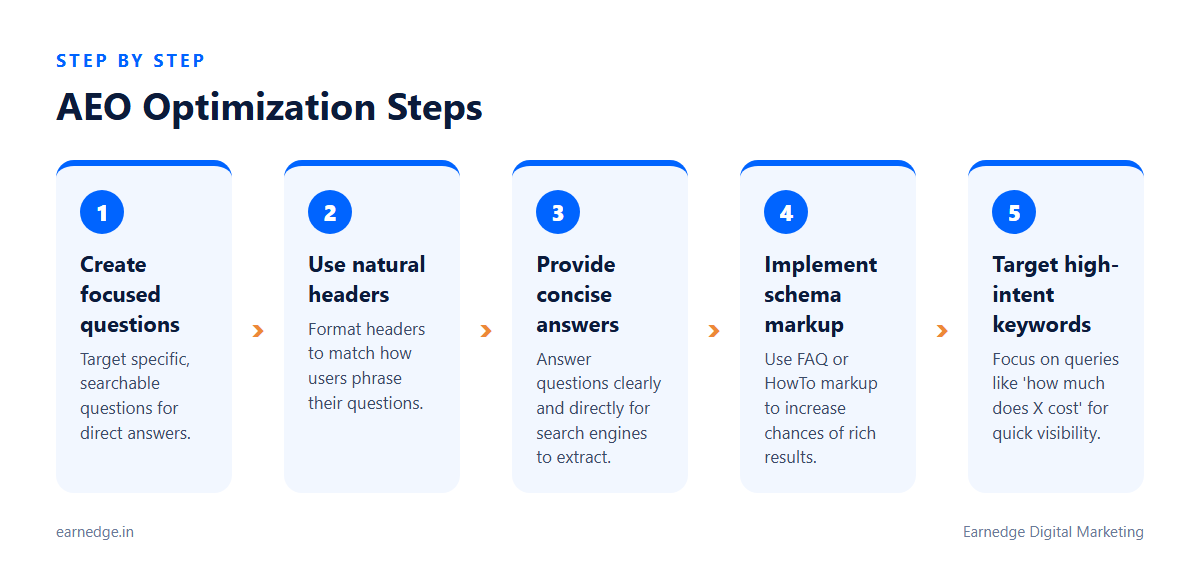
To apply AEO, create content centered on specific, searchable questions. Use header formatting that mirrors natural search language. After each question, provide concise, clear answers. Incorporating schema markup, like FAQ or HowTo, can also boost your chances of earning rich results. AEO emphasizes content that is clean, relevant, and easily understood. Businesses targeting high-intent queries, such as “how much does X cost” or “what is the best Y for Z”, often see positive outcomes quickly. AEO helps fulfill user needs immediately and improves your site’s visibility compared to competitors.
AEO is a focused aspect of SEO that addresses how search engines deliver answers, especially for short, question-based content. It supports wider SEO strategies.
Understanding GEO and Its Role in AI Search
GEO is a technique for improving a content’s visibility in search engine results pages. Princeton University researchers introduced it in a 2023 paper, and it centers on optimizing content to be chosen and cited by generative AI systems. These systems include tools like ChatGPT, Perplexity, Google Gemini, and Claude. GEO strives to ensure content is trustworthy and authoritative enough for AI engines to use when compiling responses from various sources.
Although some marketers use AEO and GEO as synonyms, a distinction is increasingly recognized. AEO, or Answer Engine Optimization, focuses on surfacing content in AI-generated answers, featured snippets, and knowledge panels. GEO, however, directly targets the outputs of generative AI models. HubSpot uses AEO as a broad term encompassing all visibility efforts.
Google AI Overviews sit at the intersection of traditional SEO and answer engine optimization. GEO is especially important for content designed for AI-powered results, such as Google’s AI Overviews. The aim of GEO is to create content that AI models can readily summarize, cite, and share with users.
AEO vs. GEO: Key Differences and Similarities
AEO and GEO are modern extensions of existing SEO strategies. While they sound interchangeable, they are not. SEO focuses on ranking in lists, while AEO aims to be quoted in Google’s search features. GEO, however, focuses on being selected as a trustworthy source material by AI models.
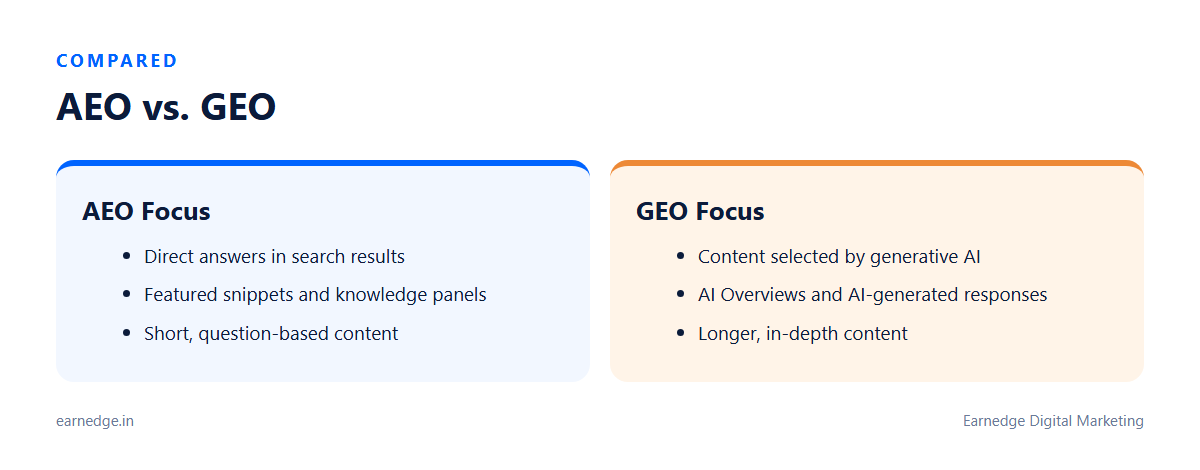
AEO stands for answer engine optimization, which involves structuring content to appear in AI-generated answers, featured snippets, and knowledge panels. It’s best suited for answering short, direct questions with structured content, using headers that match search phrases, and targeting high-intent keywords.
GEO, or generative engine optimization, aims to earn visibility in generative AI outputs from tools like ChatGPT, Gemini, and Perplexity. It helps maintain visibility even when there are no traditional snippets or blue links. In essence, AEO helps content appear as a direct answer, while GEO creates content that generative AI can summarize and cite.
The practical difference between AEO and GEO is largely terminological. Some SEO professionals use AEO for traditional search features and reserve GEO for generative AI outputs. For many teams, AEO and GEO represent the same strategy described with different words. Both address a gap that SEO alone doesn’t fill: appearing in AI-generated answers.
Why Both AEO and GEO Matter for Your SEO Strategy
Optimizing for answer engines is now a core layer of search visibility. Whether you call it Answer Engine Optimization (AEO) or Generative Engine Optimization (GEO), the underlying goal is the same: to ensure your content appears in AI-generated responses. AEO focuses on visibility in features like featured snippets and People Also Ask, while GEO specifically targets outputs from generative AI tools like ChatGPT, Gemini, and Perplexity.
The practical difference between AEO and GEO is largely terminological. SEO, AEO, and GEO strategies share common ground because they all aim to rank well in search results and AI Overviews. They are becoming the foundation of brand visibility in AI-first search. Answer-first content, schema, and entity clarity are strategies for answer engine optimization.
Build these practices into your content workflow. Track AI visibility in your reporting and use appropriate tools to understand your wins and where competitors are being cited. Keep your content helpful and credible to ensure it appears, whether read by a human or an algorithm.
How to Adjust Your Keyword Strategy for AEO and GEO
Optimizing for answer engines is now a core layer of search visibility. To succeed, adjust your keyword strategy to account for both AEO and GEO. AEO focuses on creating content that’s clean, relevant, and easy to parse. GEO, on the other hand, addresses how AI-powered search engines generate answers.
For AEO, target high-intent queries like “how much does X cost” or “what is the best Y for Z”. This approach helps your site appear before competitors even get a click. Think about featured snippets and voice search responses.
With GEO, create content that AI models can summarize and cite. Consider how AI might synthesize information from multiple sources. Consistent branding and NAP data across directories contributes to perceived trust.
Focus on search intent and build your strategy around AI-driven experiences. Remember, AEO and GEO aren’t replacing SEO, they’re expanding on it.
Tools and Techniques for AEO and GEO Optimization
Whether you call it AEO or GEO, structuring content is key to appearing in answer engines. Foundational practices improve results across both. HubSpot offers a guide to answer engine optimization.
For AEO, focus on content that provides fast, helpful answers and signals readiness for search features. Look at keywords already displaying rich results to identify opportunities for quick visibility. AEO specifically targets visibility in features like featured snippets and People Also Ask boxes.
GEO prioritizes creating reliable, comprehensive, and trustworthy content that is useful to AI. This means writing longer, in-depth pieces that cover the full context of a topic. Pick one piece of content for AEO optimization and one for GEO.
Combining both AEO and GEO strategies allows you to target quick wins while building long-term authority. Don’t be overwhelmed; start small and scale from there.
The Future of AEO and GEO in AI-Driven Search
The AEO space is evolving rapidly. AI exposure influenced conversions and conversion rates. GEO, the newest layer, was formally introduced in 2023. It focuses on optimizing content to be selected and cited by generative AI systems like ChatGPT and Gemini.
AI-influenced discovery can generate leads that match ideal customer profiles and move through the funnel faster than traditional organic traffic. More buyers are beginning their research using conversational tools like ChatGPT, Perplexity, and Gemini. Google AI Overviews are similar to featured snippets and voice search responses. AEO focuses on creating content that is clean, relevant, and easy to parse.
AEO targets specific SERP features on Google, while GEO targets the entire ecosystem of AI engines. Think of SEO as the foundation, AEO as a layer on top, and GEO as the newest layer. Strategic partnerships involve working with complementary brands.
FAQ: Common Questions About AEO and GEO
What is the difference between SEO, AEO, and GEO?
SEO aims to improve your content’s ranking in standard search engine results. AEO focuses on having your content featured directly in snippets and other search features. GEO creates detailed content designed for generative AI to summarize and reference.
What is the difference between AEO and GEO?
AEO aims for content to appear as a direct answer. GEO produces in-depth content that generative AI can summarize and cite. These two approaches serve distinct purposes.
Do I need both AEO and GEO?
AEO and GEO are valuable additions to your existing SEO strategies. A successful SEO strategy in 2026 will likely incorporate both, based on your specific goals and content.