
Google Ads Management Services: What to Expect and How to Choose
Google Ads management services should help a business make better decisions about qualified leads, sales, booked calls, or another clearly defined outcome. They are not simply a promise to “run ads” or reduce a dashboard metric.
The right scope depends on your offer, sales cycle, budget, and measurement setup. Before hiring a partner, get clear on what success means, how it will be measured, and what the team will actually review and improve.
What Google Ads management services usually include
A management engagement can include account setup, campaign structure, keyword and search-term review, ad assets, audience or geographic settings, bidding, budget pacing, landing-page recommendations, reporting, and ongoing testing. The mix should follow the business goal rather than a fixed checklist.
Google describes Search campaigns as text ads that reach people searching for products or services. Performance Max is a goal-based campaign type that can access Google Ads inventory across channels. They solve different delivery problems, so a responsible plan explains why a campaign type fits the objective instead of treating one campaign type as a universal answer. Google’s campaign-type guide is a useful starting point.
| Area | A useful management question | Weak version |
|---|---|---|
| Business goal | Which action creates value, and what makes it qualified? | “Get more clicks.” |
| Measurement | Which conversion actions inform reporting and bidding? | Counting every page view as a lead. |
| Campaign structure | Which campaigns match the offer, demand, and available assets? | Launching a standard template without a rationale. |
| Landing experience | Does the page answer the ad’s promise and make the next action clear? | Sending all traffic to a generic homepage. |
| Reporting | What changed, what did it affect, and what will be tested next? | A monthly metric dump without decisions. |
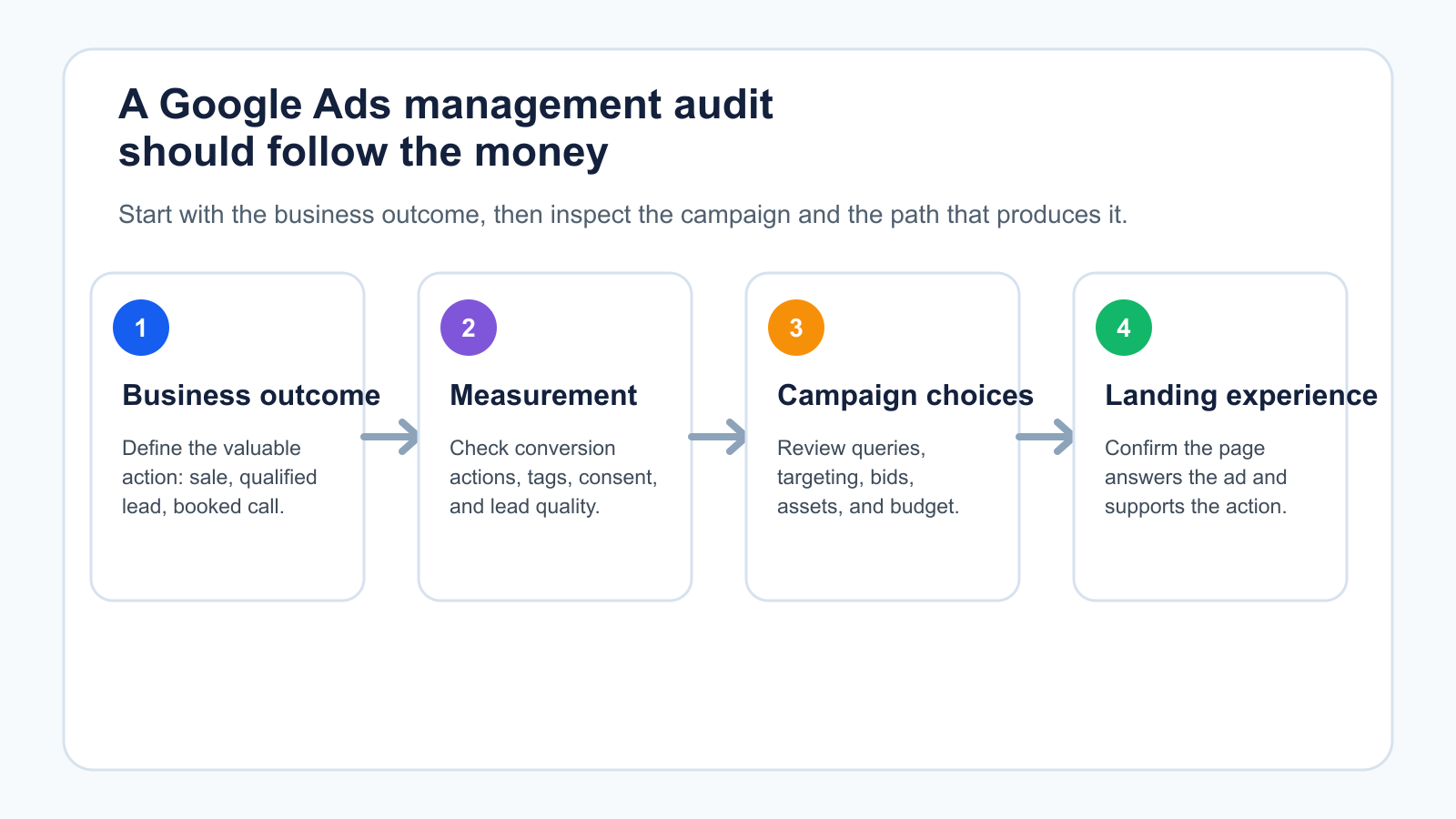
Start with the conversion, not the campaign type
For many businesses, the first useful question is: “What should count as a conversion?” Google Ads supports different conversion types, including website actions, phone calls, app actions, and offline conversions. The conversion action should reflect something the business actually values, not just the easiest action to count. See Google’s overview of conversion types.
For a lead-generation business, a form submission might be an early signal, while a qualified conversation or opportunity review may be the better business-quality signal. For ecommerce, a purchase and its value will often be more meaningful than an add-to-cart event. The point is not to create the longest event list. It is to make the account’s optimization and reporting goals understandable.
Google’s setup guidance explains that conversion-based bidding relies on conversion tracking. If tracking is incomplete or a low-value action is treated as the primary goal, a campaign can optimize toward the wrong behavior. Google’s campaign setup guidance makes that dependency explicit.
What a first account review should examine
Measurement and data quality
Check the defined conversion actions, whether tags fire when expected, whether auto-tagging is enabled, and whether the journey crosses domains. Google notes that auto-tagging and a correctly implemented site-wide tag help connect ad-click information to website conversions. Its conversion-tracking guidance also calls out cross-domain and redirect considerations.
If the sales process continues in a CRM or through offline calls, agree on how lead quality will be reviewed. Do not claim that every form fill is a customer, and do not imply that offline attribution is automatic without a verified setup.
Demand and campaign choices
Review the offer, search intent, campaign type, locations, exclusions, audience signals where applicable, assets, and budget. Search campaigns can be a fit when people are actively searching for the service being offered. Performance Max may be appropriate when the business has suitable conversion goals and creative assets, but it should still have a documented role and controls.
The decision should be traceable. For example, “This Search campaign exists to reach demand for a specific service in a defined area” is a testable purpose. “We use this because it is popular” is not.
Ad-to-page match
Ads should set an expectation that the landing page fulfills. Review the search query or audience context, ad message, page heading, proof, form or call path, speed, and mobile usability together. An ad can attract attention while the landing page fails to help a reader decide or act.
If a campaign needs landing-page improvement, that work is part of the wider conversion path. Earnedge’s web design and conversion-rate-optimization services are a relevant next step when the page, not only the media settings, is limiting the journey.
The measurement loop: where reporting becomes useful
Good reporting connects a decision to evidence. It does not turn one short reporting period into a promise about future cost per lead, revenue, or ROAS.
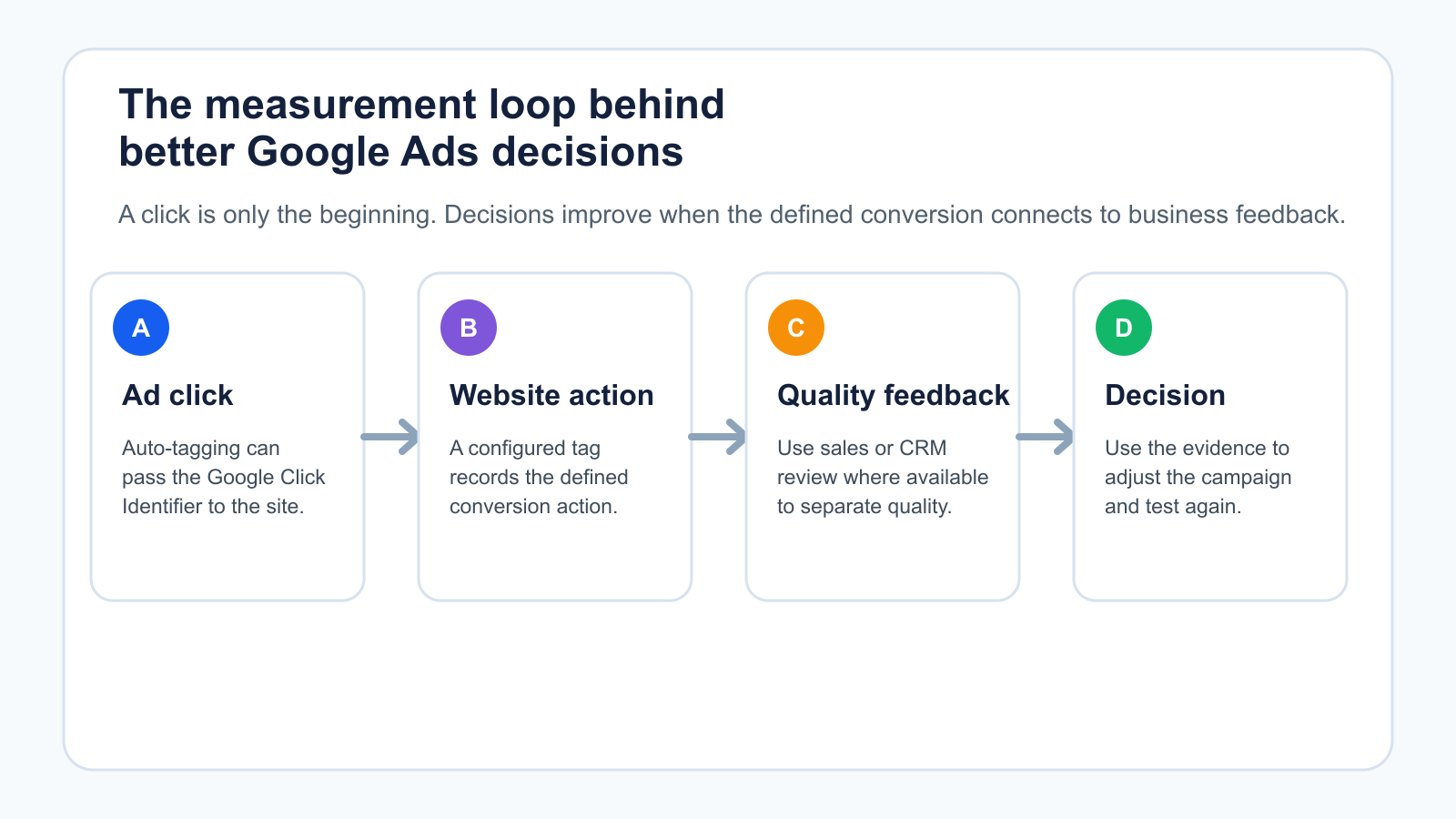
Google says conversion tracking helps advertisers understand whether ad interactions led to defined actions, such as purchases, sign-ups, or calls. It also recommends segmenting data by conversion name, category, or source when those distinctions are useful. Google’s sales-tracking guidance explains the measurement role in more detail.
| Reporting layer | Example question | Decision it can support |
|---|---|---|
| Delivery | Did the intended audience have a chance to see the campaign? | Check budget, targeting, and eligibility. |
| Website action | Did people complete the defined conversion action? | Investigate message and landing-page alignment. |
| Quality review | Did the action meet the business’s qualification standard? | Refine lead definitions and sales feedback. |
| Value | Was a value captured where the business can reliably provide it? | Choose value-based analysis cautiously. |
This is also where analytics and tracking services can support the advertising work. A campaign report is only as useful as the events and business definitions behind it.
Questions to ask before choosing a Google Ads management partner
- What business action will be the primary conversion goal, and why?
- What is included in the first audit of tracking, campaigns, search terms, assets, and landing pages?
- Which changes need approval, and how will testing decisions be documented?
- How will reporting separate ad-platform activity from qualified business outcomes?
- What access, assets, website changes, and internal feedback does the work require from us?
- Which parts of the work are ongoing management, and which are separate creative, landing-page, or tracking projects?
The answers should be specific to the business. Be cautious if a provider guarantees a fixed ranking, cost per lead, ROAS, volume of leads, or revenue before reviewing the account and its measurement.
When to involve a Google Ads management team
External management can be useful when an internal team needs a structured audit, ongoing campaign ownership, clearer tracking, more disciplined testing, or help connecting paid traffic to the landing-page and sales journey. It is not a substitute for a clear offer, a working website, or honest lead follow-up.
For a practical review of the entire path ads, tracking, landing experience, and next actions request a free growth audit. The goal is to identify what can be verified and improved, not to promise a result before the evidence exists.
Frequently asked questions
What is included in Google Ads management services?
The scope can include account and campaign review, conversion tracking checks, campaign configuration, ad assets, budget and bidding review, search-term or audience analysis, reporting, and ongoing tests. The exact work should be documented for the business and campaign goal.
Can a Google Ads agency guarantee a cost per lead or ROAS?
No responsible provider can guarantee a fixed outcome before reviewing demand, competition, the offer, tracking quality, landing experience, sales follow-up, and budget. A plan can define how results will be measured and improved, but it should keep the uncertainty visible.
Should every business use Performance Max?
No. Google positions Performance Max as a goal-based campaign type with access across Google inventory. Whether it fits depends on the goal, conversion setup, assets, controls, and the business’s ability to evaluate performance. Search campaigns or another approach may be more appropriate for a specific objective.
Why does conversion tracking matter before changing bids?
Conversion-based bidding uses the conversion data that the account defines. If that data is missing, incomplete, or built around a low-value action, the platform can make decisions against the wrong signal.


4 Comments