
What is Local SEO? The Complete Guide 2026
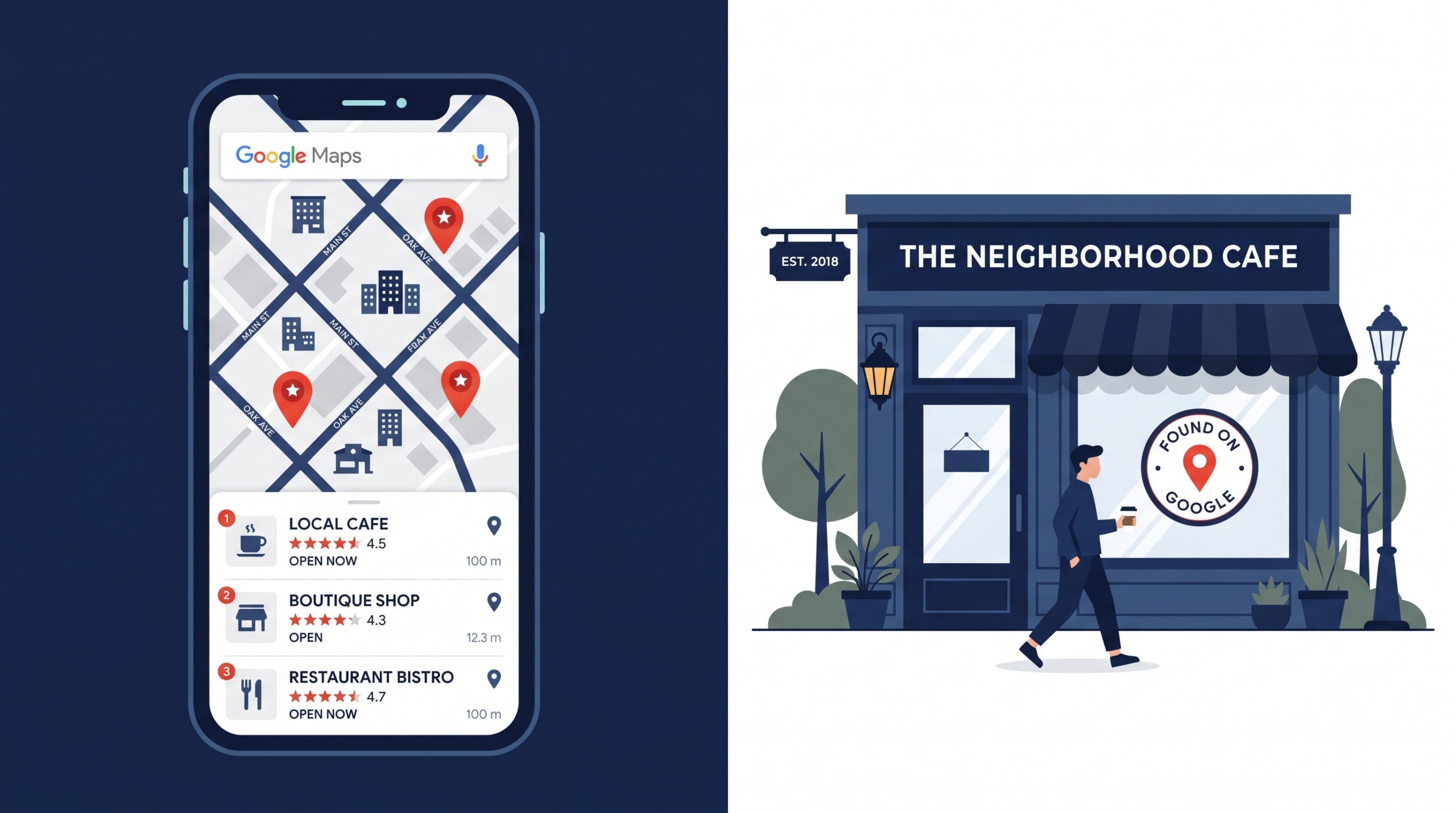
Local SEO (local search engine optimisation) is the process of optimising a business’s online presence so it appears in search results when nearby customers search for relevant products or services. It focuses on Google Maps, the Local Pack, and geographically targeted organic results helping physical or service-area businesses get found by people who are ready to buy.
Table of Contents
- What local SEO actually means
- How local SEO works
- Examples of local SEO in action
- Does local SEO still work in 2026?
- How to do local SEO – overview
- The 4 types of SEO and where local fits
- Local SEO in 2026: what’s changing
- Frequently asked questions
What Local SEO Actually Means
Local SEO is a branch of search engine optimisation focused exclusively on geographic relevance. While traditional SEO tries to rank a website for a broad audience say, anyone searching “best accounting software” – local SEO targets customers in a specific city, neighbourhood, or service area people searching “accountant in Ahmedabad” or “CA near me.”
The term covers three distinct search surfaces:
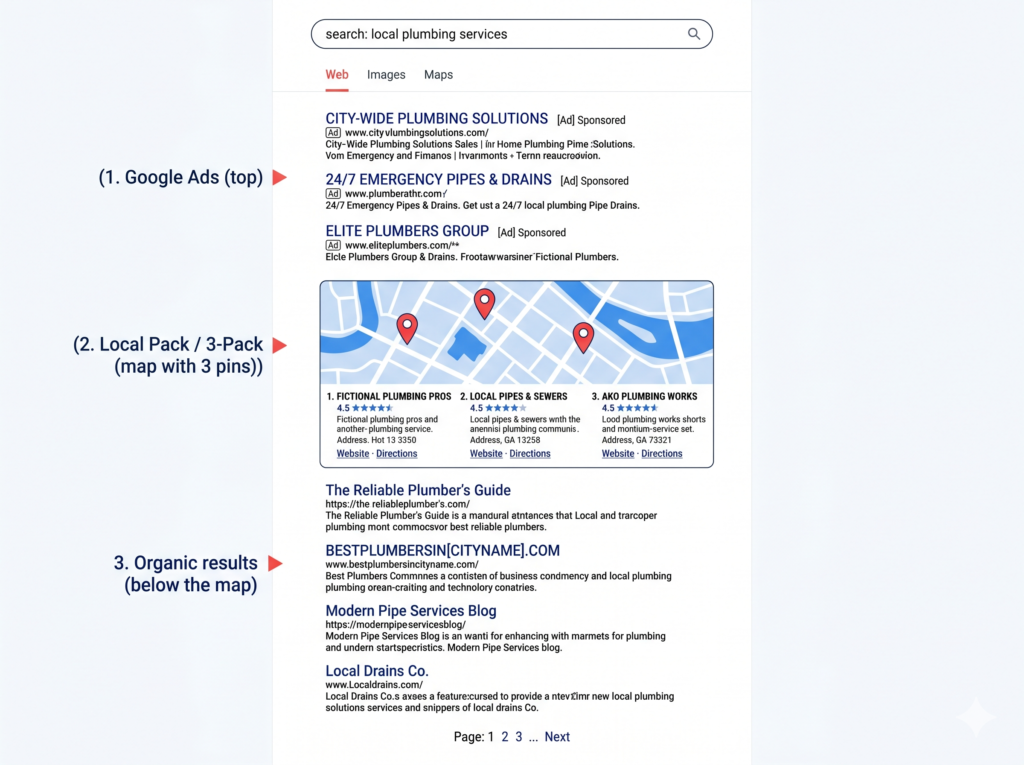
- Google’s Local Pack – the map with 3 business listings that appears above organic results for local queries
- Google Maps – where customers search for businesses directly, read reviews, and get directions
- Localised organic results – standard blue-link results where the ranking page includes a city name, neighbourhood, or location-specific content
All three are influenced by different signals, but they share one thing: the searcher’s physical location and clear local intent.
Local SEO vs Regular SEO
The fastest way to understand local SEO is to see how it differs from national or regular SEO:
| Factor | Local SEO | Regular SEO |
|---|---|---|
| Target audience | Customers within a specific city or area | National or global audience |
| Primary goal | Drive foot traffic, calls, and nearby visits | Drive organic website traffic at scale |
| Key ranking factors | GBP profile, proximity, reviews, citations | Backlinks, content depth, technical SEO |
| Main search features | Maps, Local Pack, “near me” results | Blue links, featured snippets, AI Overviews |
| Best for | Restaurants, clinics, retail, local services | SaaS, ecommerce, media, content businesses |
| Typical time to results | 2-4 months | 4-12 months |
→ For a full breakdown of which one your business needs, read our guide: Local SEO vs Regular SEO: Key Differences Explained
The 3-Pack, Maps, and Organic – How They Differ
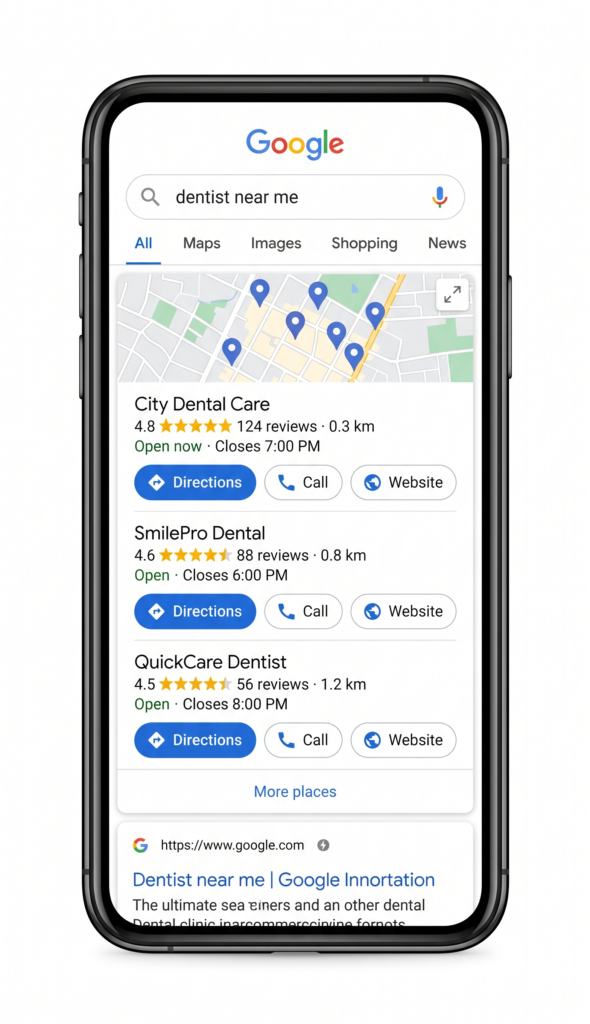
When someone searches “dentist near me” in Google, three different things can appear:
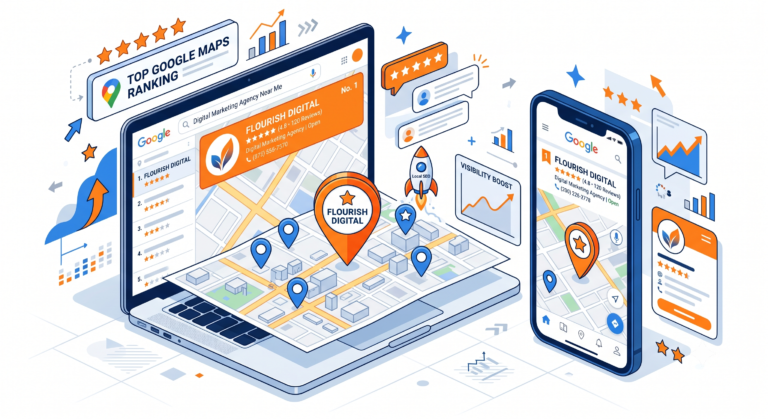
The Local Pack (3-Pack): Three business cards with a map, ratings, hours, and a call button. These are pulled from Google Business Profiles. Ranking here requires GBP optimisation, review signals, and proximity – not your website’s domain authority.
Google Maps: A dedicated maps search that shows a longer list of local businesses. This is where most high-purchase-intent searches happen. 72% of consumers who conduct a local search visit a store within 5 miles.
Organic results: Below the map, these are standard page rankings. They require on-page optimisation with location-specific content and work alongside – not instead of – a GBP strategy.
How Local SEO Works
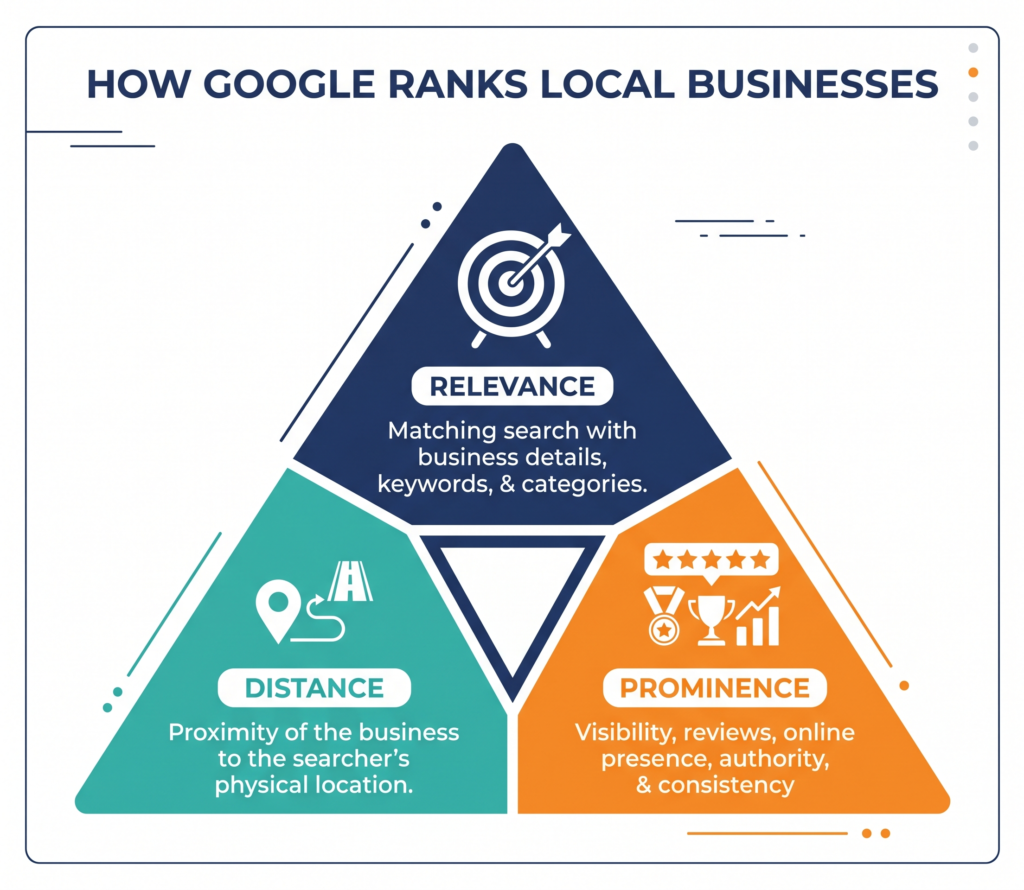
Google uses a unique three-factor algorithm for local rankings – separate from its standard PageRank-based system:
Factor 1 – Relevance
Does the business match what the searcher is looking for? Google determines this through:
- GBP categories – the primary and secondary business categories you select
- Keywords in your business description and posts
- Services listed on your GBP profile
- Website content that mirrors what the profile claims
A dental clinic that lists itself under “General Dentist” but also adds “Cosmetic Dentist” and “Emergency Dental Care” as secondary categories will be relevant for a wider range of searches than one with only a single category.
Factor 2 – Distance
How close is the business to the person searching? This is determined by the searcher’s physical location (GPS, Wi-Fi data, IP address) and, for queries with an explicit location (“dentist in Navrangpura”), Google maps the named location.
Distance is the factor you can influence the least directly – but you can expand your relevance across a larger service area by creating dedicated location pages for each city or neighbourhood you serve.
Factor 3 – Prominence
How well-known and trusted is the business online? Google measures prominence through:
- Review count and average rating on Google
- Number and consistency of citations (your business listed on directories like Justdial, Sulekha, IndiaMART, Yelp)
- Backlinks from local websites (newspapers, industry associations, local blogs)
- Overall domain authority of your website
The Role of Google Business Profile
Google Business Profile (GBP) – formerly Google My Business – is the single most important tool in local SEO. It is a free business listing that controls how your business appears across Google Search, Maps, and AI-powered answers.
A fully completed GBP profile includes:
- Business name, address, phone number (NAP)
- Primary + secondary business categories
- Opening hours (including special hours for holidays)
- Business description (750 characters – include your primary keyword naturally)
- Photos (exterior, interior, team, products – minimum 10 photos)
- Services or menu items
- Regular GBP posts (weekly updates, offers, events)
- Q&A section (seed your own common questions)
External resource: Google’s official guide to setting up Google Business Profile
Citations, Backlinks, and Reviews – The 3 Pillars
Citations are online mentions of your business’s Name, Address, and Phone number (NAP). Consistency matters more than volume – one inconsistency (e.g., “Road” vs “Rd” in your address) across dozens of directories signals distrust to Google’s local algorithm. Priority citation sources for Indian businesses: Justdial, Sulekha, IndiaMART, IndiaBizList, TradeIndia, Yellow Pages India.
Reviews are the most visible trust signal in local SEO. Google’s algorithm weighs review recency, volume, rating, and the presence of keywords in review text. A steady stream of new reviews beats a burst of old ones.
Local backlinks signal offline prominence. Links from local news publications, industry associations, chambers of commerce, local blogs, and event sponsors carry significantly more local SEO weight than generic directory links.
Examples of Local SEO in Action
Example 1 – Dental Clinic Ranking for “Dentist Near Me”
Teeth Care Centre, a dental clinic in Ahmedabad, wants to rank when someone nearby searches “dentist near me” or “dental clinic in Navrangpura.” Their local SEO strategy involves:
- Fully optimising their GBP profile under “General Dentist” and “Cosmetic Dentist” categories
- Creating a dedicated website page for each service (“teeth whitening Ahmedabad”, “braces clinic Navrangpura”)
- Listed on Justdial, Practo, and Sulekha with consistent NAP data
- Running a review request process after every appointment – reaching 200+ Google reviews at 4.7 stars
- Publishing monthly GBP posts about seasonal dental offers
Result: Appears in the Local Pack for 12+ local dental queries, driving 80+ appointment calls per month from organic search alone.
Example 2 – Restaurant Ranking in Google Maps
A family restaurant in Satellite, Ahmedabad wants to appear when people search “restaurants near Satellite” or “North Indian food near me.”
Their local SEO moves:
- Adding 40+ photos of food, interiors, and the team to GBP restaurants with photos get 42% more requests for directions (Source: Google)
- Enabling the “menu” section on GBP with dish names and prices
- Responding to every Google review both positive and negative
- Creating a location page on their website: “Best North Indian Restaurant in Satellite, Ahmedabad”
- Getting featured in a Ahmedabad food blogger’s “Top 10 restaurants in Satellite” article a high-value local backlink
Result: 3-Pack ranking for 8 local food queries. 320 monthly visits from Maps alone.
→ Ready to set this up yourself? Read our step-by-step guide: How to Do Local SEO Yourself
Does Local SEO Still Work in 2026?
Short answer: Yes, and it works better than ever for local businesses.
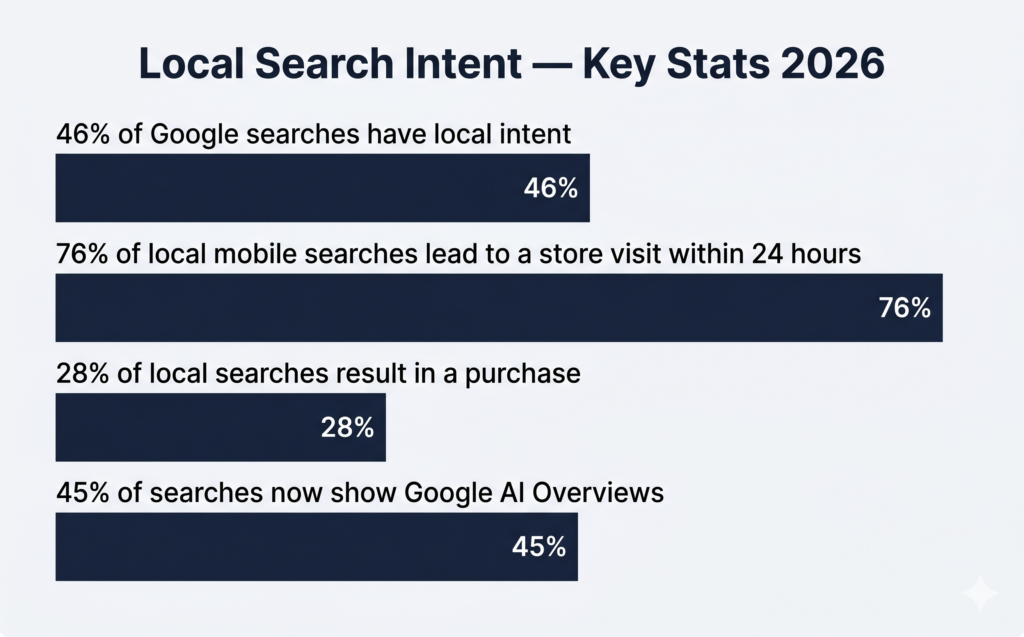
The way local search delivers results has shifted, but the demand from local searchers has not. Here is the data:
- 46% of all Google searches have local intent (Source: Google)
- 76% of people who search for something nearby on a smartphone visit a related business within a day (Source: Google)
- 28% of local searches result in a purchase (Source: Junto)
- Google AI Overviews now appear in 45%+ of searches but for local queries, they still pull from GBP and prominently-ranked local pages
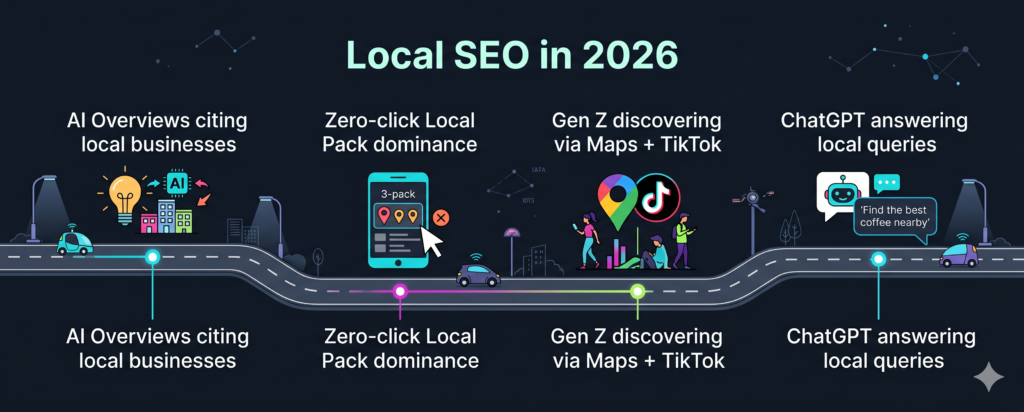
The biggest shift in 2026 is where local results appear. AI Overviews are surfacing business recommendations in conversational formats, zero-click results are growing, and Google Maps has become a standalone discovery platform especially for Gen Z users.
What this means: businesses that relied purely on organic blue-link rankings need to diversify to GBP, Maps, and AI-citation-ready content. Local SEO has not died it has expanded.
→ Read the full analysis with data: Is Local SEO Dead in 2026? Here’s What the Data Says
How to Do Local SEO – Overview
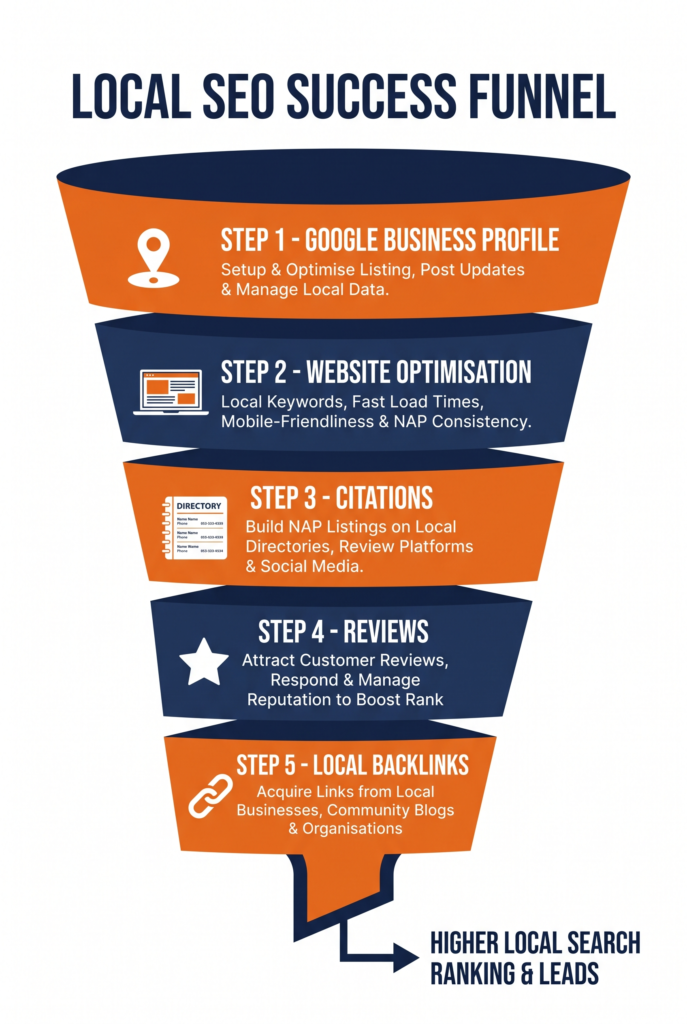
Here is the complete local SEO process in five steps. Each step links to a more detailed guide where available.
Step 1 – Claim and Optimise Your Google Business Profile
If you have not claimed your GBP listing, start here: Google Business Profile Manager. Complete every field. Do not skip categories, business description, services, or photos. An incomplete GBP is the single biggest reason businesses don’t appear in the Local Pack.
Key actions:
- Select the most accurate primary category
- Add 3-5 secondary categories
- Write a 750-character description using your primary keyword naturally
- Upload a minimum of 10 photos (exterior, interior, team, products/menu)
- Publish one GBP post per week
Step 2 – Optimise Your Website for Local Keywords
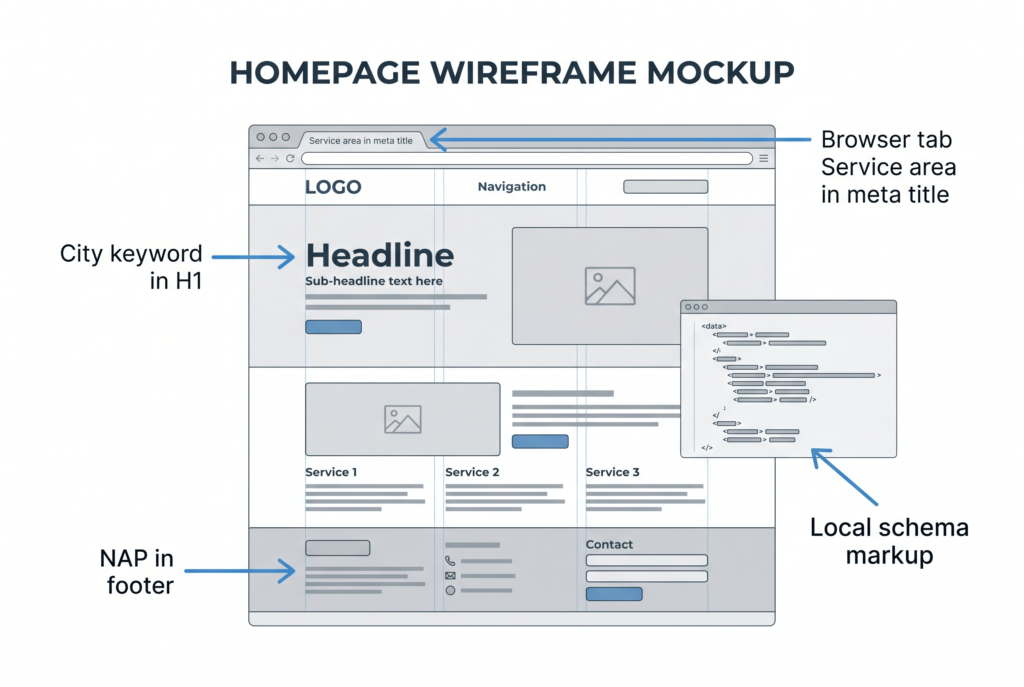
Your website must reinforce what your GBP profile claims. Create:
- A homepage with your city/area name in the H1, first paragraph, and title tag
- Individual service pages for each service you offer one page per service, not everything on one page
- Location pages if you serve multiple cities one unique page per city (not copied content with city name swapped)
- NAP in the website footer exact same format as your GBP listing
External resource: Google’s SEO Starter Guide
Step 3 – Build Local Citations
Submit your business to the top local directories in your category. For Indian businesses, the priority list is:
| Directory | Type | Priority |
|---|---|---|
| Justdial | General | 🔴 High |
| Sulekha | General | 🔴 High |
| IndiaMART | B2B | 🔴 High |
| Practo | Healthcare | 🔴 High (if relevant) |
| Zomato/Swiggy | Restaurants | 🔴 High (if relevant) |
| Yellow Pages India | General | 🟡 Medium |
| TradeIndia | B2B/Services | 🟡 Medium |
| IndiaBizList | General | 🟡 Medium |
| Bing Places | Search engine | 🔴 High |
| Apple Maps | Maps | 🔴 High |
Critical rule: Your business name, address, and phone number must be identical across every listing. Even small differences – “Mumbai” vs “Bombay”, “+91” vs “091” – create citation inconsistency that dilutes local ranking power.
External resource: Moz Local Citation Guide
Step 4 – Earn Google Reviews (Ethically)
Reviews are the most visible trust signal in local SEO and the easiest thing a competitor cannot copy quickly. Google’s guidelines prohibit incentivised reviews – but you can absolutely ask customers to leave honest feedback.
The 3-message review system:
- In-person ask after service delivery: “Was everything okay today? Would you mind sharing your experience on Google? It really helps us.”
- WhatsApp/SMS follow-up (within 24 hours): “Hi [Name], thank you for visiting us. If you have 2 minutes, we’d really appreciate a Google review – here’s the link: [GBP review shortlink]”
- Email follow-up (Day 3 if no review): “[Subject]: A quick favour from [Business Name]”
Getting your review link: Go to your GBP profile → Get more reviews → Copy the short URL.
External resource: Google’s policy on reviews
Step 5 – Build Local Backlinks
Unlike national SEO where backlinks from any high-DA site help, local SEO weights backlinks from locally relevant sources more heavily.
Highest-value local link sources:
- Local news and media get featured in Ahmedabad Mirror, Times of India city edition, or local digital news sites
- Local business associations chamber of commerce, industry associations, business directories with editorial links
- Sponsorships sponsor a local event, charity, school competition these almost always include a website mention
- Local bloggers “top 10” lists, neighbourhood guides, city food/lifestyle blogs
- Supplier/partner pages ask vendors you work with to list you on their website’s “partners” or “clients” page
→ Want to know exactly which actions drive 80% of your local ranking results? Read: The 80/20 Rule of Local SEO
The 4 Types of SEO and Where Local Fits
SEO is not a single discipline. There are four main types, and local SEO is one of them:
| Type | What it covers | Best for |
|---|---|---|
| On-page SEO | Content quality, keyword optimisation, meta tags, internal linking | Every website foundational |
| Technical SEO | Site speed, crawlability, mobile responsiveness, Core Web Vitals, schema | Every website foundational |
| Off-page SEO | Backlinks, brand mentions, PR coverage, digital PR | Competitive industries, national brands |
| Local SEO | GBP optimisation, Maps visibility, NAP citations, local keywords, reviews | Any business with a physical location or service area |
Most local businesses need all four working together. Technical SEO ensures Google can crawl your site. On-page SEO ensures your pages are relevant. Off-page and local SEO build the authority and geographic signals that push you into the Local Pack.
→ Read the full breakdown: The 4 Types of SEO Explained
Local SEO in 2026: What’s Changing
AI Overviews are reshaping local discovery
Google AI Overviews now summarise local business recommendations in conversational answers. When someone asks “what’s the best dentist in Banjara Hills?”, an AI Overview may list 2-3 businesses before any map or organic result appears.
What this means for you: Your GBP profile data, review sentiments, and website content are now being parsed not just for rankings but for AI answer extraction. Structured content, FAQ schema, and clear NAP data make you more likely to be cited in these AI answers.
Zero-click searches are growing – but local intent still drives visits
Zero-click searches (where users get their answer without visiting any website) are increasing. For local businesses, this is less of a threat than it sounds – the Local Pack itself is a zero-click result that still drives phone calls, direction requests, and website visits directly from the SERP.
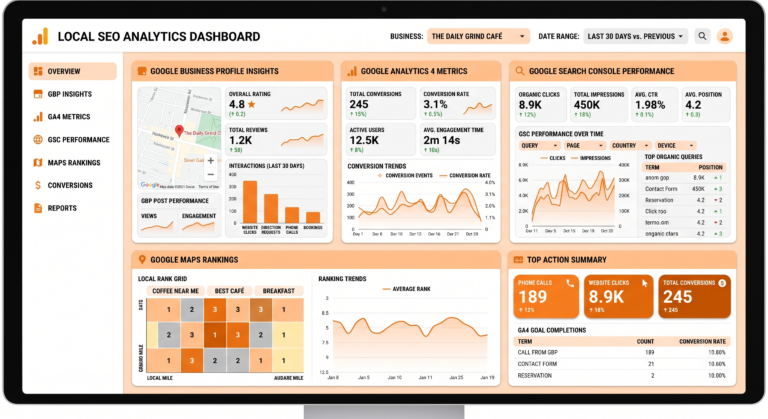
Data: Google Business Profile listings generate an average of 1,009 searches per month for the typical business. Of those, 5% result in a website visit, 5% a direction request, and 3% a phone call.
Gen Z is using Maps and TikTok for local discovery
A growing segment – especially 18-28 year olds – now discovers local restaurants, salons, and services through TikTok videos, Instagram Reels tagged with locations, and direct Maps searches rather than Google’s organic results.
Action: Create short-form content (Reels, Shorts) that tags your business location. Enable your business on Google Maps to collect user-generated photos and reviews. The signal from Maps engagement feeds back into local SEO rankings.
ChatGPT and Perplexity are answering local queries
More users are asking AI assistants – ChatGPT, Perplexity, Google’s Gemini – questions like “which accounting firm in Pune has the best reviews?” These platforms pull from publicly accessible web content and GBP data.
Action: Keep your website and GBP profile regularly updated. AI tools cite sources that are well-structured, clearly authored, and recently updated.
→ Full analysis of what’s changing: The Future of Local SEO in 2026 → Can AI tools actually do the work for you? Can ChatGPT Do SEO?
What is an example of local SEO?
A dental clinic in Ahmedabad optimising its Google Business Profile, building 200+ Google reviews, and ranking for “dentist near me” is a classic example of local SEO in action. Other examples include a restaurant appearing in the top 3 of Google Maps for “North Indian food in Satellite”, a plumber ranking for “emergency plumber Pune”, or a law firm showing up in the Local Pack for “divorce lawyer Bengaluru.” Any business using geographic search signals to attract nearby customers is practising local SEO.
Can I do local SEO myself?
Yes. The foundational steps – claiming your Google Business Profile, optimising your website with local keywords, building citations on major directories, and requesting reviews – can all be done without hiring an agency. Most business owners can complete the initial setup in under 10 hours. Ongoing maintenance (monthly GBP posts, review responses, new citations) takes 2-3 hours per month. For a full walkthrough, read: How to Do Local SEO Yourself.
How long does local SEO take to work?
Most businesses see measurable improvements in Google Maps visibility within 4-8 weeks of completing their GBP profile and building core citations. Reaching the Local Pack for competitive keywords typically takes 3-6 months. Review velocity and local backlink building are the longest-lead investments – allow 6-12 months for their full effect to compound.
What is the difference between local SEO and regular SEO?
Local SEO targets customers in a specific geographic area and optimises for the Google Local Pack, Maps, and “near me” queries. Regular SEO targets a broader (national or global) audience and focuses on organic blue-link rankings. Local SEO uses Google Business Profile and citations as its core tools; regular SEO relies more heavily on backlinks, domain authority, and large-scale content production. Read the full comparison: Local SEO vs Regular SEO.
Is local SEO worth it for small businesses?
Yes, local SEO consistently delivers the highest ROI of any digital marketing channel for businesses with a physical location or defined service area. A dental clinic ranking in the Local Pack can generate 80+ enquiries per month from organic search alone, at zero ongoing cost per click. Compared to Google Ads (which stops driving leads the moment you stop paying), local SEO builds a compounding asset. Read: Is Local SEO Dead or Worth It?.
How much does local SEO cost?
DIY local SEO costs only your time. Hiring a freelancer for monthly local SEO management typically ranges from ₹8,000-₹25,000/month in India depending on scope. A full-service local SEO agency runs ₹20,000-₹80,000/month for a single location. For most small businesses, a hybrid approach set up foundations yourself, hire for ongoing content and outreach offers the best return. See our Free Local SEO Checklist to understand exactly what’s involved before spending anything.
What to Do Next
You now have a complete foundation in what local SEO is, how it works, and what’s changing in 2026. Here is the fastest path forward:
- Start with the checklist download our 30-point Local SEO Checklist 2026 and audit where your business stands today
- Follow the step-by-step guide How to Do Local SEO Yourself takes you from GBP setup to local backlinks in a single guide
- Understand the landscape Local SEO vs Regular SEO helps you decide exactly where to invest your time
- Stay current The Future of Local SEO covers what AI Overviews and Gen Z search behaviour mean for your strategy right now

6 Comments