
Boost Your D2C Brand Growth with Smart Digital Marketing Strategies
What is D2C Digital Marketing?
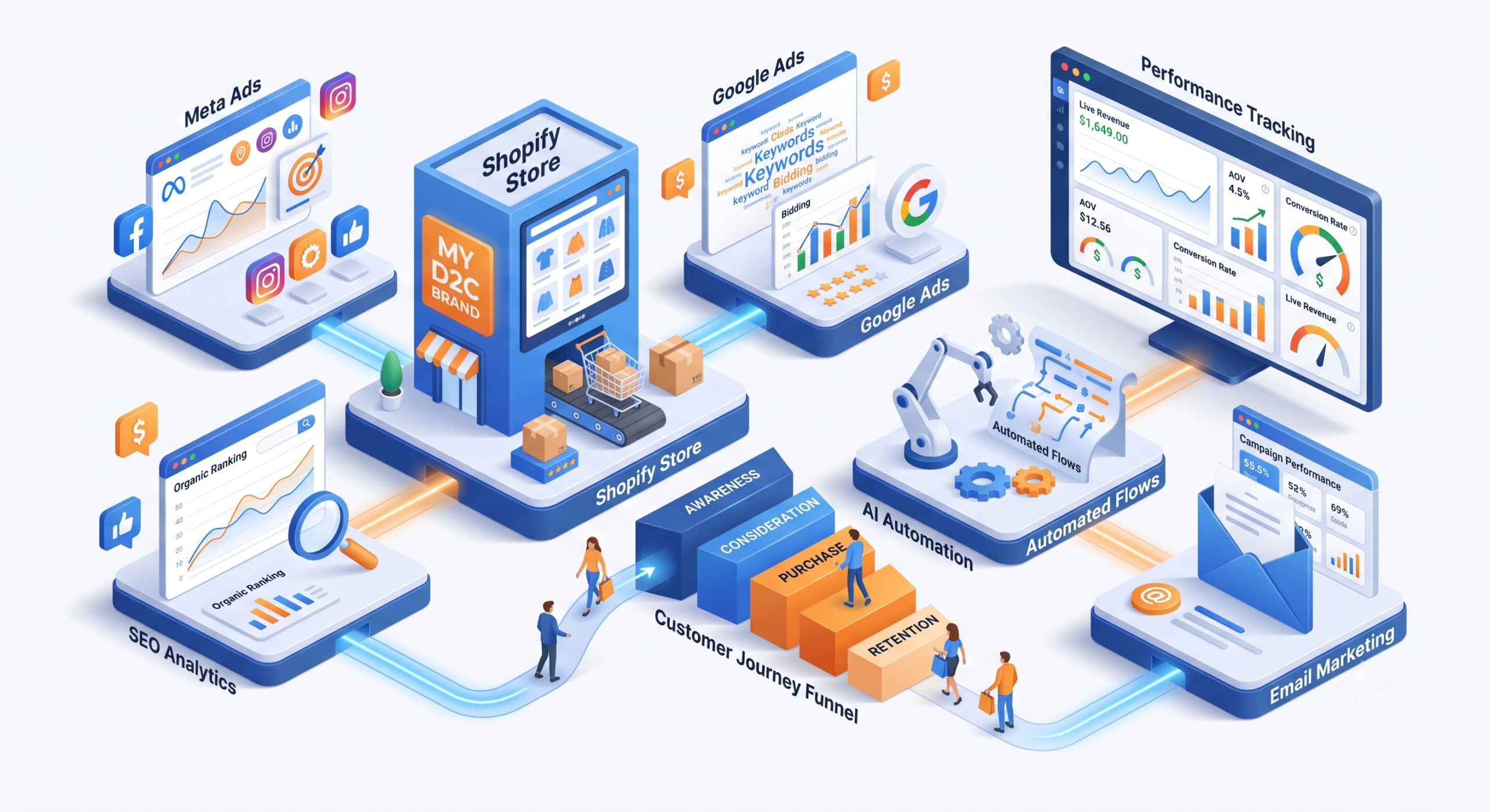
D2C digital marketing is the process of promoting and growing a direct-to-consumer brand using digital channels such as SEO, Google Ads, Meta Ads, email marketing, content marketing, influencer partnerships, AI automation, and conversion optimization. The goal is to acquire customers directly, improve retention, and maximize customer lifetime value without relying on third-party retailers.
What Is D2C Digital Marketing?
Direct-to-Consumer (D2C) digital marketing refers to promoting products directly to customers through online channels without relying on wholesalers, distributors, or retail stores.
Unlike traditional retail models, D2C brands own the entire customer journey—from the first ad impression to repeat purchases. This allows businesses to collect first-party customer data, build stronger relationships, and optimize every stage of the buying experience.
A successful D2C marketing strategy typically combines:
- Performance marketing
- Search engine optimization (SEO)
- Content marketing
- Email marketing
- SMS marketing
- Conversion rate optimization
- Marketing automation
- Customer retention campaigns
These channels work together to create a predictable growth engine rather than depending on a single source of traffic.
If your website is not optimized to convert visitors into customers, investing more in advertising may increase costs without improving profitability. Our Web Design & CRO Services focus on improving landing pages, product pages, and checkout experiences to maximize conversions.
Why Digital Marketing Is Essential for D2C Brands
Consumers now discover, compare, and purchase products online. This makes digital marketing one of the most important growth drivers for D2C businesses.
A strong digital marketing strategy helps you:
- Increase brand awareness
- Acquire high-intent customers
- Reduce customer acquisition costs
- Build customer trust
- Improve conversion rates
- Increase repeat purchases
- Generate measurable return on investment (ROI)
Unlike traditional advertising, digital marketing provides real-time performance data. Every campaign, click, conversion, and purchase can be measured and optimized.
Businesses that combine multiple marketing channels generally create more stable and sustainable growth than businesses relying on only one platform.
The Complete D2C Marketing Funnel
Growing a D2C brand requires more than attracting traffic. You need a structured customer journey that guides potential buyers from awareness to long-term loyalty.
1. Awareness
At this stage, customers discover your brand for the first time.
Effective channels include:
- Meta Ads
- Google Display Ads
- Instagram Reels
- YouTube
- Influencer collaborations
- SEO blog content
Educational articles, buying guides, and product comparisons help build awareness while improving organic visibility.
2. Consideration
Customers begin comparing products, reading reviews, and evaluating alternatives.
Improve this stage with:
- Product comparison pages
- Customer testimonials
- Product videos
- Buying guides
- Frequently Asked Questions
Strong SEO content also supports consideration. For example, if your business serves local customers, resources such as our Local SEO Services page and What Is Local SEO? The Complete Guide (2026) demonstrate how educational content can attract qualified visitors before they become customers.
3. Purchase
The purchase stage should remove every possible obstacle.
Key optimization areas include:
- Fast-loading product pages
- Mobile-friendly design
- Clear pricing
- Trust badges
- Secure checkout
- Multiple payment options
- Transparent shipping information
Our Web Design & CRO Services help optimize these conversion points to reduce cart abandonment and increase sales.
4. Retention
Acquiring a customer is only the beginning.
Retention strategies include:
- Email campaigns
- Loyalty programs
- Product recommendations
- Replenishment reminders
- Personalized offers
Returning customers often generate higher lifetime value and lower acquisition costs than new customers.
5. Advocacy
Satisfied customers become your best marketing channel.
Encourage advocacy by:
- Requesting reviews
- Launching referral programs
- Featuring user-generated content
- Sharing customer success stories
Authentic recommendations increase trust and reduce reliance on paid advertising.
Best Digital Marketing Channels for D2C Brands
No single marketing channel can consistently drive sustainable growth. High-performing D2C brands diversify their acquisition strategy while ensuring every channel supports the customer journey.
Meta Ads
Meta Ads remain one of the most effective channels for reaching new audiences through Facebook and Instagram.
Use Meta Ads for:
- Product launches
- Brand awareness
- Retargeting campaigns
- Dynamic product ads
- Lookalike audiences
High-quality creative assets and compelling offers are essential for maximizing return on ad spend (ROAS).
If you’re looking to scale paid campaigns, our Performance Marketing Services help businesses build profitable Meta and Google Ads strategies.
Google Ads
Google Ads target customers with existing purchase intent.
Campaign types include:
- Search Ads
- Shopping Ads
- Performance Max
- Display Ads
- YouTube Ads
Unlike social media advertising, Google captures users who are actively searching for products or services, making it one of the highest-intent acquisition channels.
Search Engine Optimization (SEO)
Paid advertising generates immediate traffic, but SEO creates sustainable long-term growth.
An effective ecommerce SEO strategy includes:
- Keyword research
- Technical SEO
- Product page optimization
- Category page optimization
- Internal linking
- Content marketing
- Core Web Vitals optimization
Publishing educational content also builds topical authority.
For businesses targeting local customers, our Local SEO resource hub includes:
- Local SEO Services
- What Is Local SEO? The Complete Guide (2026)
- Google Business Profile Optimization
- Local Keyword Research
- Local Citation Management
- Review & Reputation Management
- Local SEO Reporting
These guides demonstrate how supporting content strengthens your overall search visibility while helping customers solve real problems.
Shopify Growth Strategy
A visually appealing Shopify store is only one part of a successful ecommerce business. The stores that consistently grow focus on creating a seamless shopping experience that encourages visitors to complete their purchase and return again.
Your website should be optimized for both users and search engines.
Optimize Product Pages
Every product page should answer the questions a customer is likely to ask before making a purchase.
Include:
- High-quality product images
- Lifestyle images
- Product videos
- Detailed descriptions
- Benefits instead of only features
- Size guides
- Shipping information
- Return policy
- Customer reviews
- Frequently Asked Questions
Well-optimized product pages improve user experience while increasing organic search visibility.
Improve Site Speed
Website speed directly affects user experience, conversion rates, and search rankings.
Optimize by:
- Compressing images
- Using modern image formats
- Minimizing unnecessary apps
- Enabling browser caching
- Optimizing JavaScript and CSS
- Choosing fast Shopify themes
You can measure your website performance using Google PageSpeed Insights and monitor Core Web Vitals through Google Search Console.
Reduce Cart Abandonment
Many visitors add products to their cart but leave before completing checkout.
Reduce abandonment by:
- Offering guest checkout
- Displaying trust badges
- Showing estimated delivery dates
- Supporting multiple payment options
- Displaying transparent shipping costs
- Sending abandoned cart emails
These improvements can significantly increase your conversion rate without increasing ad spend.
For businesses looking to maximize website performance, explore our Web Design & CRO Services to improve landing pages, product pages, and checkout experiences.
Email & SMS Marketing
Paid advertising helps acquire customers, but email and SMS marketing help retain them.
Successful D2C brands build owned marketing channels rather than depending entirely on paid traffic.
Essential Email Automations
Set up automated workflows for:
- Welcome emails
- Abandoned cart recovery
- Browse abandonment
- Order confirmation
- Shipping updates
- Product review requests
- Reorder reminders
- Win-back campaigns
Automation keeps customers engaged while increasing repeat purchases.
Customer Segmentation
Instead of sending every customer the same email, segment your audience based on:
- Purchase history
- Browsing behavior
- Average order value
- Product category
- Customer lifetime value
- Geographic location
Personalized campaigns consistently outperform generic email blasts.
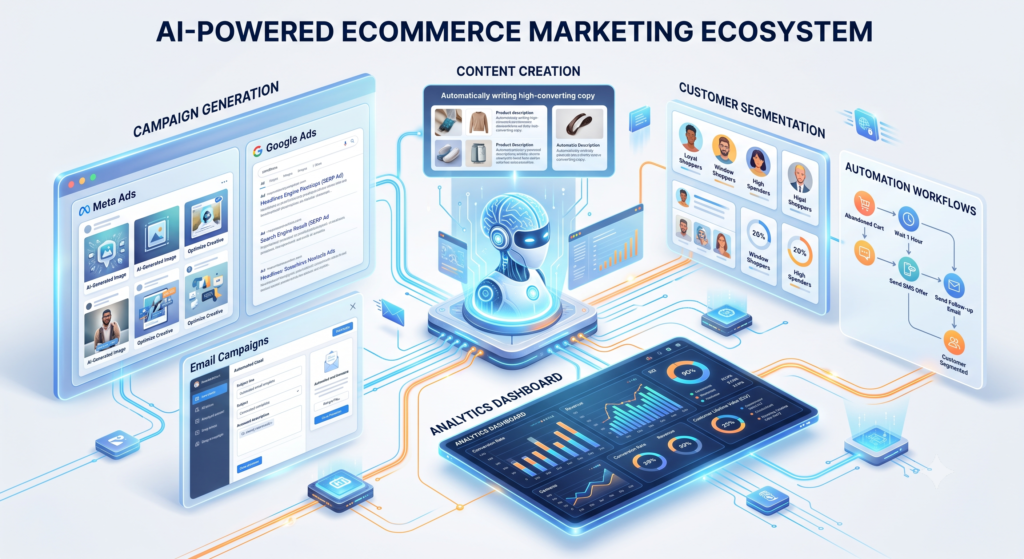
AI in D2C Marketing
Artificial Intelligence has become a competitive advantage for ecommerce businesses.
Instead of replacing marketers, AI improves speed, personalization, and decision-making.
Modern D2C brands use AI for:
AI Copywriting
Generate:
- Product descriptions
- Email campaigns
- Blog articles
- Meta descriptions
- Ad copy
Always review AI-generated content before publishing to maintain accuracy and brand voice.
AI Ad Creatives
AI tools can generate:
- Product banners
- Lifestyle images
- Social media creatives
- Video concepts
- Ad variations
This allows marketers to test more creative variations without significantly increasing production costs.
Marketing Automation
Automation tools can:
- Trigger personalized emails
- Recommend products
- Segment customers
- Score leads
- Schedule campaigns
- Predict customer behavior
The result is a more personalized customer experience with less manual effort.
Measuring D2C Marketing Success
Marketing should always be measured using business outcomes rather than vanity metrics.
Track these key performance indicators (KPIs):
| KPI | Why It Matters |
|---|---|
| Customer Acquisition Cost (CAC) | Cost to acquire one customer |
| Return on Ad Spend (ROAS) | Revenue generated from advertising |
| Customer Lifetime Value (LTV) | Long-term customer profitability |
| Average Order Value (AOV) | Revenue per order |
| Conversion Rate | Percentage of visitors who purchase |
| Repeat Purchase Rate | Customer retention |
| Email Revenue | Revenue generated from email campaigns |
| Organic Traffic | Long-term SEO growth |
| Returning Customer Rate | Brand loyalty indicator |
Review these metrics monthly to identify trends and optimize your marketing strategy.
Build a Unified Marketing Dashboard
Instead of reviewing each platform separately, combine your data into one dashboard.
Track data from:
- Google Analytics 4
- Google Search Console
- Shopify Analytics
- Meta Ads
- Google Ads
- Email Marketing Platform
This provides a complete view of customer acquisition and revenue performance.
Common D2C Marketing Mistakes
Many ecommerce businesses struggle because they focus on tactics instead of building a complete growth system.
Avoid these common mistakes:
- Relying on a single traffic source
- Ignoring SEO in favor of paid advertising
- Sending generic email campaigns
- Neglecting customer retention
- Running ads without conversion optimization
- Publishing thin content
- Failing to measure marketing performance
- Ignoring website speed
- Not testing landing pages
- Making decisions without data
Sustainable growth comes from continuously improving every stage of the customer journey.
Frequently Asked Questions
What is D2C digital marketing?
D2C digital marketing is the process of promoting and selling products directly to consumers using channels such as SEO, paid advertising, email marketing, social media, AI automation, and ecommerce optimization.
Which marketing channel is best for D2C brands?
There is no single best channel. The most successful brands combine SEO for long-term visibility, Google Ads for high-intent traffic, Meta Ads for customer acquisition, and email marketing for retention.
Is SEO important for Shopify stores?
Yes. SEO helps Shopify stores generate consistent organic traffic, reduce dependence on paid advertising, and attract customers actively searching for products.
How does AI help ecommerce businesses?
AI improves marketing efficiency by assisting with content creation, campaign optimization, customer segmentation, product recommendations, predictive analytics, and marketing automation.
How much should a D2C brand spend on marketing?
Marketing budgets vary based on business goals, margins, and growth stage. Instead of focusing on a fixed percentage, monitor CAC, ROAS, and LTV to determine whether your marketing investment is profitable.
Final Thoughts
Successful D2C brands do not rely on a single marketing tactic. They build an integrated growth system where every channel supports the next. Paid advertising attracts new customers, SEO generates long-term organic traffic, optimized websites improve conversion rates, email marketing increases repeat purchases, and AI automation improves efficiency across the entire customer journey.
The businesses that grow consistently are those that treat digital marketing as an ongoing process of testing, learning, and optimization rather than a one-time campaign.
At EarnEdge, we help businesses build scalable digital marketing systems that combine performance marketing, search engine optimization, website optimization, lead generation, and marketing automation into a unified growth strategy.
Explore our services to learn more:
- Performance Marketing Services
- SEO Services
- Web Design & CRO Services
- Lead Generation Systems
- Local SEO Services


3 Comments