Understanding AEO, GEO, and SEO
Understanding AEO, GEO, and SEO
AEO (Answer Engine Optimization) and GEO (Generative Engine Optimization) optimize content for platforms like Google AI Overviews and ChatGPT, a shift from traditional SEO’s focus on search engines. These new approaches are increasingly important for online visibility and often demand unique strategies. This article clarifies the differences between AEO and GEO, explains their relationship to traditional SEO, and details how to measure their effectiveness.
What Are Answer Engines and How Are They Changing Search?
The SEO industry faces new challenges, including Google pushing organic results further down the page with features like AI Overviews. Increasingly, users are also leaving traditional search engines for AI-based options like ChatGPT and Gemini. These AI tools, known as answer engines, provide direct answers without necessarily sending users to a website.
Generative AI systems like ChatGPT, Perplexity, and Google Gemini use content when synthesizing responses. SEO focuses on ranking pages in traditional search results to earn clicks. Answer Engine Optimization (AEO) aims to have content extracted and displayed as direct answers in features like featured snippets and voice assistants. Generative Engine Optimization (GEO) focuses on making content trustworthy enough to be cited by generative AI systems. At HubSpot, AEO is the umbrella term for all answer-engine visibility initiatives, while GEO specifically refers to optimization for generative AI outputs.
Buyers are increasingly starting their research in places other than traditional rankings. Generative AI optimization (GEO) aims to have AI systems cite content when synthesizing responses. Visibility within answer engines, citation accuracy, and referral traffic from AI sources are now important metrics to track.
AEO: Optimizing for Concise, Authoritative Answers
Answer Engine Optimization, or AEO, is about structuring content to provide direct answers that answer engines can easily extract. It’s a shift in focus from ranking pages in traditional search results to creating content that can be displayed as a direct answer in Google AI Overviews, featured snippets, and voice assistants, often without a click. AEO isn’t replacing traditional SEO; instead, it’s expanding what SEO means. The technical foundations of SEO, such as crawlability and site speed, remain essential for AEO to function.
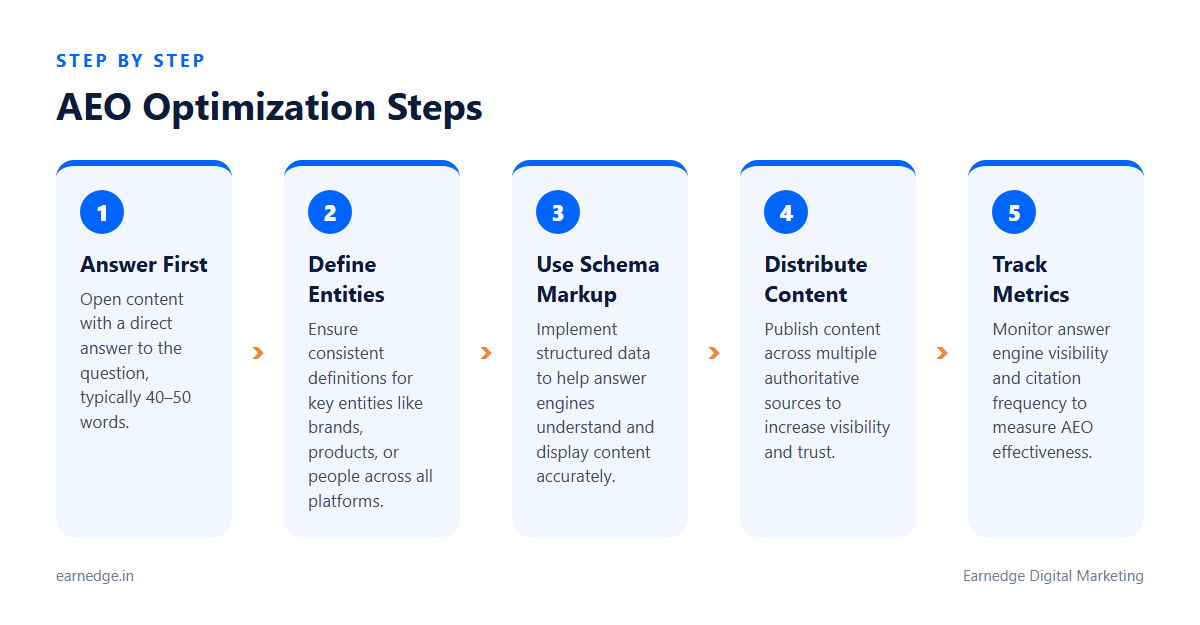
A core AEO tactic is to answer the question first, then elaborate. This “answer-first” approach means surfacing the most important point immediately. For example, content addressing “What is Answer Engine Optimization?” should define AEO in the first sentence. Content should open with a direct answer, typically 40–50 words.
Optimizing for answer engines is now a core layer of search visibility. It’s becoming the foundation of brand visibility in AI-first search. Whether you use AEO or another term, the goal is structured, answer-first content with clear entity definitions.
GEO: Generating Detailed, Conversational Content
Generative Engine Optimization (GEO) is a new optimization approach focused on influencing how generative AI systems, like ChatGPT, Perplexity, and Google Gemini, synthesize information. While Answer Engine Optimization (AEO) targets specific features within traditional search results, GEO aims to ensure your content is selected and cited when these AI engines answer questions. Think of GEO as a strategic layer built on a foundation of SEO and AEO.
To improve visibility in generative engine responses, incorporate authoritative statistics and use persuasive writing styles. Fluency and a clear, consensus-building structure are also essential. Well-designed textual enhancements can increase source visibility by as much as 40%, and adding citations and quotations significantly improves visibility.
GEO goes beyond technical authority and answer clarity; it requires building trust with AI systems. This involves using entity-based content, structuring data in a way that’s friendly to large language models (LLMs), and distributing content across multiple platforms. Some marketers use AEO as a broad term for all efforts to improve visibility in AI-generated responses. AI systems select content based on factors such as long-form, keyword-rich pages and authoritative, well-cited content.
Traditional SEO: The Foundation of Search Visibility
Traditional SEO remains essential for online visibility. It focuses on ranking in standard search results through practices like keyword research, building backlinks, ensuring technical crawlability, and establishing authority signals. Traditional SEO creates the conditions that make visibility in AI-powered search more likely. Essentially, it’s the practice of improving content to rank higher on search engine results pages, primarily Google.
Newer strategies like Answer Engine Optimization (AEO) and Generative SEO (GEO) are emerging, but they build upon this existing foundation. Technical SEO, including website speed and crawlability, is a foundational requirement for both traditional SEO and AI visibility. Domain authority remains important, although AI selection now considers additional signals.
Optimizing for answer engines is now a core layer of search visibility. AEO isn’t an add-on; it’s becoming the foundation of brand visibility in AI-first search.
Why AEO and GEO Are Now Essential for Visibility
Optimizing for answer engines is now a core layer of search visibility. AEO isn’t an add-on; it’s becoming the foundation of brand visibility in AI-first search. Whether you use AEO or GEO, the goal is structured, answer-first content with clear entity definitions.
AEO and GEO are terms used to differentiate between traditional search features and generative AI outputs. While marketers use these terms differently, both focus on making content visible in AI-generated responses. GEO goes further, aiming to be selected as a trustworthy source by AI models. This is distinct from traditional SEO, which focuses on ranking in lists.
SEO teams will now report on AEO. Metrics like answer engine visibility and citation frequency are becoming essential components of search reporting. If your brand isn’t appearing in generative results, it represents a performance gap. Tools are available to track citations, prompts, and competitor benchmarking.
Authority, Consistency, and Entity Management: Keys to Success
Building authority, maintaining consistency, and managing entities are crucial for success with both Answer Engine Optimization (AEO) and Generative Engine Optimization (GEO). Entity management involves defining key entities, like brands, products, or people, and ensuring those definitions remain consistent across all online appearances. This consistency allows AI systems to reliably connect references back to your brand. Inconsistent information, conversely, can confuse AI and lead to inaccurate connections.
AEO and GEO strategies share common tactics, including answer-first content, schema markup, and distribution across authoritative sources. A successful strategy focuses on creating content that AI systems can trust. GEO strategy incorporates technical authority built through SEO, such as a strong domain and backlinks.
PR, content partnerships, and third-party coverage are vital, functioning as AEO infrastructure. Repetition of core messages across platforms reinforces entities and ensures broader reach, as only a small percentage of an audience typically sees a single piece of content. Tracking metrics such as answer engine visibility and entity consistency will become standard for SEO teams.
AEO vs. GEO: Is There a Difference?
Although often used as synonyms, AEO and GEO represent distinct approaches. Answer engine optimization (AEO) centers on structuring content to be cited or displayed in AI-generated answers, featured snippets, and knowledge panels. Generative engine optimization (GEO) describes the effort to gain visibility in outputs from tools like ChatGPT, Gemini, and Perplexity. Some professionals see AEO as relating to traditional search features, while GEO specifically targets generative AI.
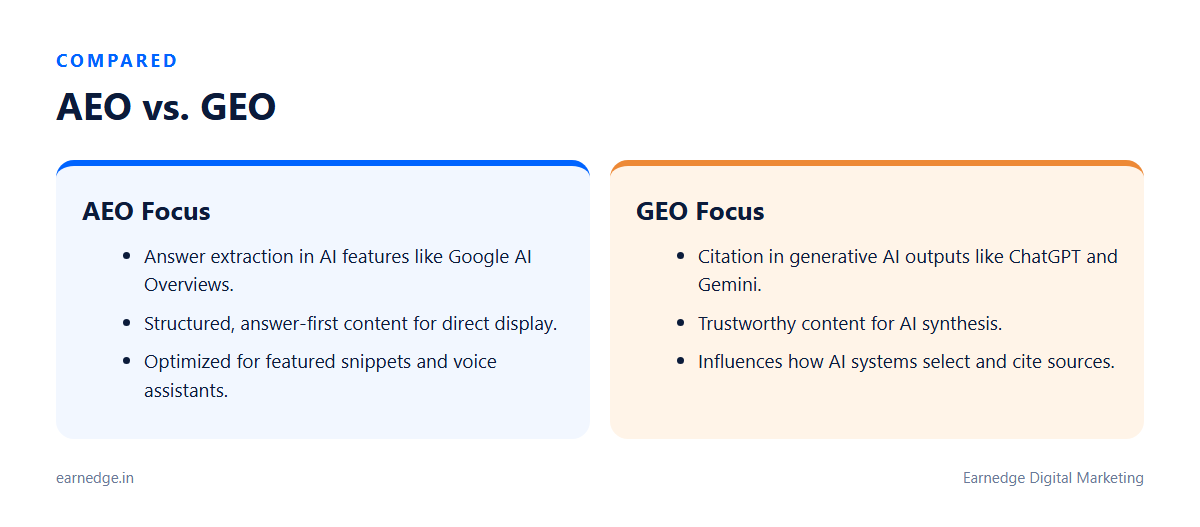
Many marketers consider AEO and GEO to represent the same objective. HubSpot uses AEO as a broad term for all efforts to improve visibility in answer-driven experiences. The fundamental work remains consistent: creating structured content with clear entity definitions and reliable information. Appearing in AI-synthesized responses is one method for AI systems to select content. Both AEO and GEO address a limitation of traditional SEO: the ability to appear in AI-generated answers.
Do I Need Both AEO and GEO Strategies?
For most teams, you don’t need separate AEO and GEO strategies. One strategy can produce content answer engines can extract and trust. One strategy can produce content that answer engines can extract and trust.
AEO and GEO aren’t distinct content programs, but rather different labels for the same work. This work includes structured content, clear entity definitions, direct answers, and consistent information across the web. The important distinction isn’t AEO versus GEO, but rather answer engine optimization versus traditional SEO.
While both AEO and GEO address the gap that traditional SEO doesn’t, appearing in AI-generated answers, GEO builds upon both SEO and AEO. AEO strategies improve AI answer visibility and trust. A GEO strategy aims to become a trusted source for AI systems.
How Do I Get My Brand Cited in ChatGPT or Perplexity?
To increase your brand’s visibility in AI-powered platforms like ChatGPT or Perplexity, focus on creating content that these engines find trustworthy and useful. Use answer-first formatting and define entities consistently. Answer engines can lift short, authoritative statements or data points directly into summaries. Implement relevant schema to provide structure for AI engines.
Beyond your website, reinforce these facts across authoritative external surfaces, such as press releases, partner pages, and industry publications. Adding citations and authoritative statistics can also improve visibility. Persuasive writing styles and a clear, consensus-building structure are helpful too.
Measuring your success involves tracking AI visibility and citation coverage, which indicates how often your brand appears in AI experiences. This goes beyond traditional SEO metrics like rankings and click volume. Agencies like Rivetline are focusing on entity-based content and LLM-friendly data structures to ensure brands are cited by engines like Perplexity, ChatGPT, and Gemini.
FAQ: AEO, GEO, and SEO Explained
What is the difference between SEO, AEO, and GEO?
SEO aims to improve content ranking in standard search engine results pages. AEO and GEO focus on appearing in AI-generated answers. These practices are evolving, but none replaces the others.
What is SEO, AEO, and GEO?
SEO involves optimizing content to rank higher in traditional search engine results pages. Answer Engine Optimization (AEO) and Generative Engine Optimization (GEO) are related practices. AEO strategies, such as concise summaries and schema markup, can boost AI visibility and build trust.
Do I need both AEO and GEO strategies?
For many teams, AEO and GEO represent the same strategy described differently. The key distinction is between answer engine optimization and traditional SEO. Both AEO and GEO address a limitation of SEO: appearing in AI-generated answers.