
B2B Lead Generation Services in India: What to Expect and How to Choose
B2B lead generation services should help a business build a repeatable way to attract, capture, qualify, and learn from potential buyers. The useful question is not simply “How many leads will we get?” It is whether the service connects a defined audience and offer to a measurable sales process.
The right scope depends on the sales cycle, buying committee, existing website, channel mix, and the team’s ability to follow up. Before choosing a provider, agree on what counts as a useful lead, who owns each handoff, and which evidence will guide the next decision.
What B2B lead generation services should include
A lead-generation engagement can include audience and offer research, demand-generation campaigns, landing pages or lead forms, conversion tracking, CRM routing, qualification design, reporting, and ongoing testing. Not every business needs every component immediately. A useful plan makes the boundaries clear instead of packaging unrelated work under one vague promise.
| Area | A useful question | Warning sign |
|---|---|---|
| Audience | Which industries, roles, company sizes, and problems are in scope? | “Anyone who might be interested.” |
| Offer | What specific next step is valuable enough for a prospect to take? | Sending paid traffic to a generic homepage. |
| Capture | What information is necessary to support a relevant follow-up? | A long form with no reason for each question. |
| Qualification | What makes a response worth sales time? | Treating every submission as an equal opportunity. |
| Measurement | Which events and business outcomes will be reviewed? | Reporting clicks or raw leads without context. |
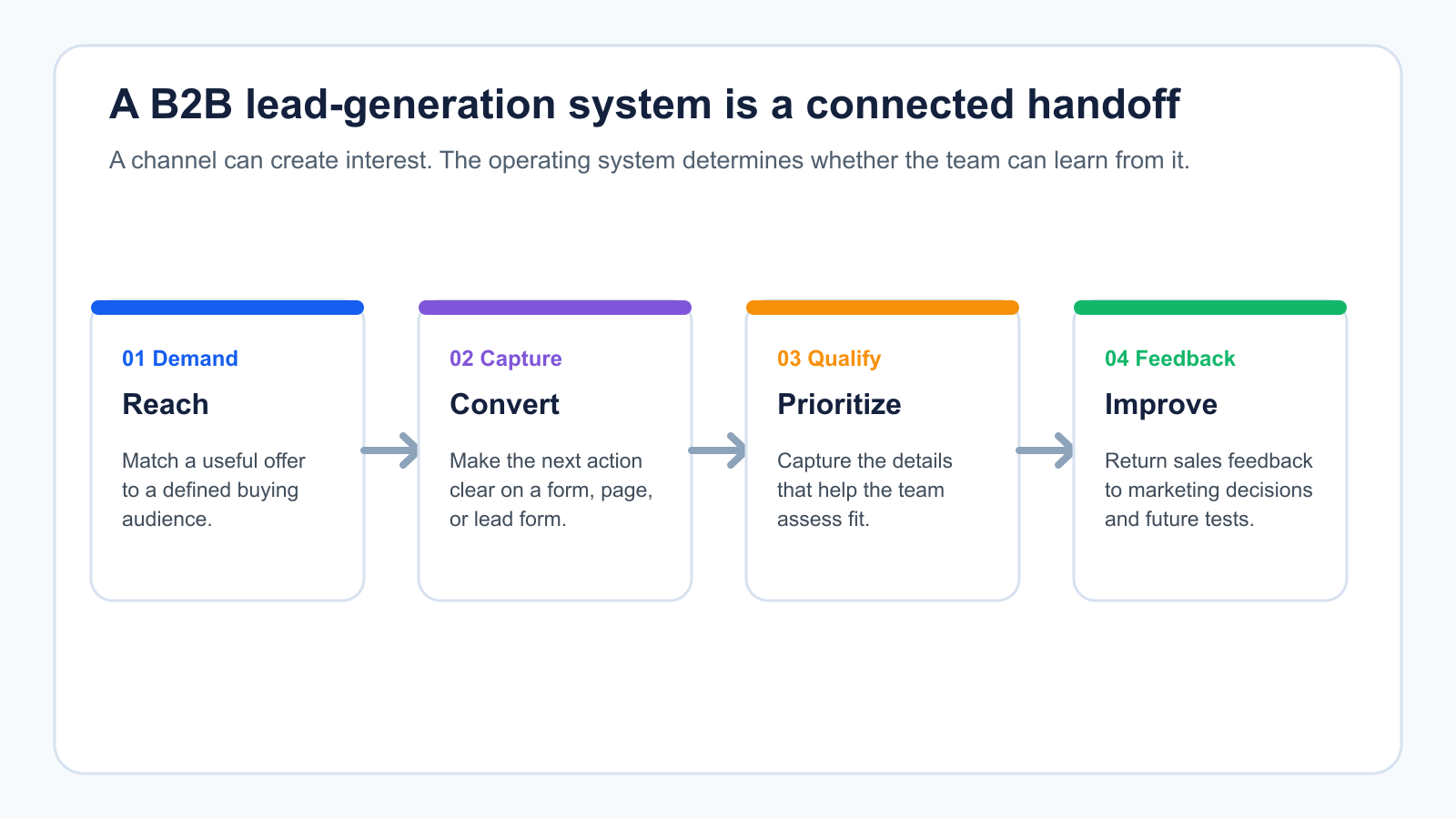
Start by defining a qualified lead
“Lead” is not one universal business outcome. A completed form may show interest, but the sales team may need to know the person’s role, company fit, need, timing, or ability to buy before treating it as a qualified opportunity.
Define a small set of stages in plain language. An enquiry may become a marketing-qualified lead only after it meets agreed criteria, while a sales-qualified lead may require a conversation or review by the sales team. The exact labels matter less than a shared definition and a way to preserve it in reporting.
Google Analytics 4 can automatically measure form_start and form_submit when enhanced measurement is enabled, and it recommends generate_lead for a form submission or request for information. Those events are useful signals, but they do not independently prove that the lead is a good fit. Google’s lead-generation measurement guidance and its recommended events reference explain the distinction between recorded actions and business context.
If Google Ads lead forms are part of the plan, Google requires a privacy-policy URL and supports lead delivery through options such as download, email notifications, API, or webhooks. For Search campaigns, qualifying responses can label matching submissions as qualified in the lead data. Review Google’s lead-form documentation before deciding whether that workflow fits the business.
Build the delivery plan around the buyer’s next step
The service should make it clear why a channel, landing experience, and follow-up path belong together. A webinar registration, request for a proposal, demo request, assessment, or useful resource can each be valid next steps when it fits the buyer’s stage. The offer must match what the business can deliver and what the audience has reason to want.
Demand channels need a stated role
Search, paid social, LinkedIn, partnerships, outbound activity, content, and referrals can all play different roles. Do not choose a channel merely because it is popular. Specify the audience, message, offer, budget or effort, and the action the channel is expected to support.
For paid search, the related Google Ads management guide explains why conversion definitions and landing-page alignment need to be in place before campaign decisions are treated as meaningful. For B2B campaigns on LinkedIn, LinkedIn’s own campaign guide frames audience definition, offer, landing page, and nurture as connected elements. It is a platform resource, not proof that LinkedIn is right for every business.
Capture and routing should not be an afterthought
Ask where a lead lands, what happens immediately after submission, how the record reaches the right person, and what context is retained. A campaign can create interest while the operating process loses it through an unclear owner, missing notification, or delayed response.
This is where analytics and tracking services can support the wider system. The goal is not to record every possible event. It is to make the events and handoffs that matter reliable enough to inform decisions.
Use a feedback loop to improve lead quality
A meaningful lead-generation review joins marketing activity with sales feedback. The team should be able to see what was captured, whether it met the agreed criteria, whether follow-up happened, and what needs to change next. This keeps the work from being optimized only for a low-friction form completion.
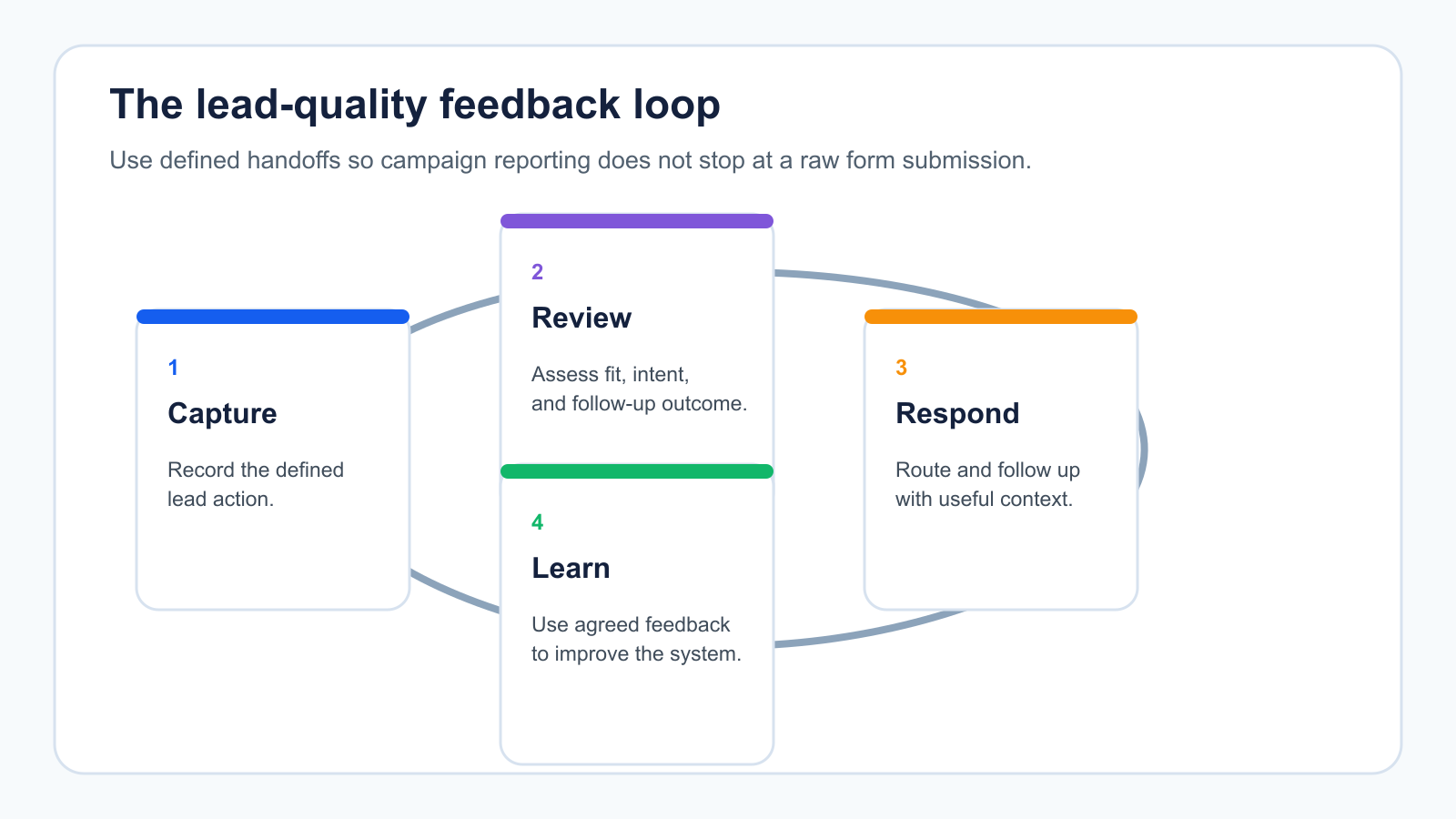
| Signal | Owner | Question it answers | Possible next decision |
|---|---|---|---|
| Form or lead-form submission | Marketing | Did the defined conversion occur? | Check campaign delivery and the capture experience. |
| Qualification details | Marketing and sales | Does the enquiry meet agreed fit criteria? | Refine targeting, offer, or qualification fields. |
| Follow-up status | Sales | Was the lead contacted through the agreed process? | Fix routing, ownership, or response workflow. |
| Sales feedback | Sales and marketing | What did conversations reveal about fit and intent? | Update messaging, exclusions, and future tests. |
Questions to ask before choosing a B2B lead generation partner
- What is the primary business outcome, and which earlier actions will be measured alongside it?
- How will the team define a qualified lead for this sales process?
- What is included in the first audit of audience, offer, website, tracking, CRM routing, and follow-up?
- Which channels are proposed, and what role does each play in the buyer journey?
- Who owns campaign changes, sales feedback, and approval of new tests?
- What access, assets, privacy review, and internal input are required from the business?
Be cautious if a provider guarantees a fixed number of leads, meetings, revenue, or cost per lead before reviewing the offer, demand, tracking, sales process, and budget. A responsible plan can explain the measurement method and the work to be done without presenting uncertain outcomes as promises.
What the first working phase should produce
Early work should create clarity, not a rush to claim results. A practical first phase can document the ideal customer profile, the offer, conversion definitions, existing tracking, lead-routing path, channel roles, and the first set of tests. The resulting plan should make it easier for marketing and sales to decide what evidence would justify a change.
For a broader review of paid acquisition, landing pages, tracking, and lead flow, see Earnedge’s lead generation services or request a free growth audit. The purpose of an audit is to identify observable gaps and priorities, not to promise an outcome before the relevant evidence exists.
Earnegde is As seen on DesignRush Top Digital Marketing Companies in India | 2026.
Frequently asked questions
What do B2B lead generation services include?
The scope may include audience and offer work, channel strategy, campaigns, landing pages or lead forms, tracking, CRM routing, qualification design, reporting, and testing. The right combination depends on the business and its sales process.
How do you measure B2B lead quality?
Use shared criteria that are meaningful to the business, then connect form or campaign activity with qualification and sales feedback. A submission can be counted as an action without being treated as a qualified opportunity.
Which channel is best for B2B lead generation in India?
There is no universal best channel. Choose based on where the intended audience can be reached, the buyer’s next step, the offer, the available creative and landing experience, and the team’s ability to measure and follow up.
Can a provider guarantee a number of qualified leads?
No responsible provider can guarantee a fixed outcome before reviewing the business context, offer, audience, demand, tracking, sales follow-up, and budget. The engagement should define how evidence will be reviewed and how the system will be improved.


5 Comments