
D2C Digital Marketing Strategy in Ahmedabad: 7 Ways to Grow Your Brand
If you run a D2C brand in Ahmedabad, you already know that getting your first few hundred customers is not the hard part. The hard part is building a D2C digital marketing strategy that keeps working after the initial burst of orders from friends, family, and early Instagram followers fades out.
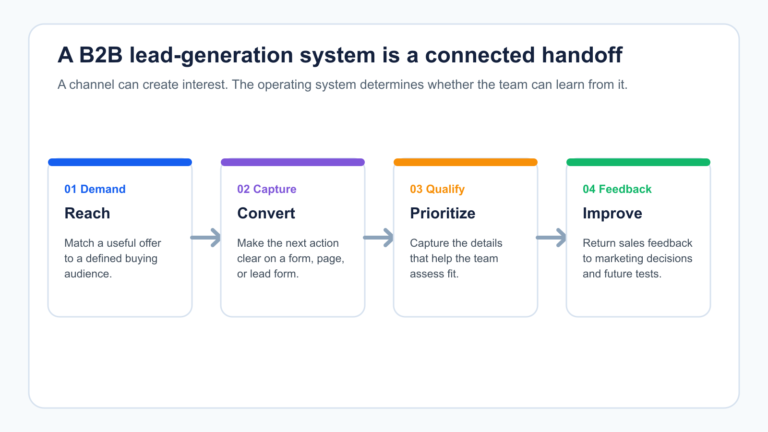
Most D2C founders start with one channel usually Meta Ads or a bit of influencer outreach and scale it until costs rise and returns shrink. A stronger approach treats acquisition, conversion, and retention as one connected system, not a series of unrelated campaigns. This article breaks down what that system looks like for an Ahmedabad D2C brand, and seven practical ways to build it.
What Is a D2C Digital Marketing Strategy?
A D2C digital marketing strategy is the plan a brand uses to find customers, sell to them directly through its own website or app, and keep them coming back without relying on a retail middleman or marketplace like Amazon or Flipkart.
Because there’s no retail partner doing merchandising, discovery, or customer data collection on your behalf, the brand owns every part of the journey: the ad that brings someone in, the product page that convinces them, the checkout that completes the sale, and the email or WhatsApp message that brings them back for a repeat purchase.
How a D2C strategy differs from traditional marketing
Traditional retail marketing is built around distribution getting shelf space, running trade promotions, and building brand recall so a shopper picks your product off a shelf. D2C marketing is built around data and direct relationships. You know exactly who bought, what they paid, how they found you, and whether they came back. That data is the actual advantage of the D2C model, and a good strategy is built to use it.
The main goals of a D2C marketing strategy
Most D2C marketing strategies are working toward four things at the same time:
- Acquiring new customers at a sustainable cost
- Converting a higher share of visitors into buyers
- Increasing average order value (AOV)
- Improving repeat purchase rate and customer lifetime value (LTV)
A strategy that only focuses on the first goal bringing in traffic tends to look good on ad dashboards and bad on the profit and loss statement.
Why Ahmedabad’s D2C Brands Need a Multi-Channel Marketing Strategy
Ahmedabad consumers rarely discover, research, and buy a product in one place. Someone might see a product on Instagram, search for reviews on Google, compare it on a marketplace, and finally buy it from the brand’s own website after seeing a retargeting ad. A single-channel strategy misses most of that journey.
Building awareness
Awareness channels social ads, influencer content, and content marketing introduce the brand to people who aren’t actively searching for it yet. This is where most new-to-brand customers first hear about you.
Capturing high-intent demand
Once awareness exists, some people start searching directly for the brand name, a product category, or a comparison with competitors. Search-based channels exist specifically to capture that intent before a competitor does.
Converting website visitors
Traffic is only useful if the website turns visitors into buyers. This is where product pages, pricing clarity, trust signals, and checkout experience decide whether the spend on the previous two stages was worth it.
Retaining existing customers
Acquiring a new D2C customer in Ahmedabad typically costs several times more than retaining an existing one. Email, WhatsApp, and SMS marketing to your existing customer base is usually the highest-ROI activity available to a D2C brand, yet it’s often the most neglected.
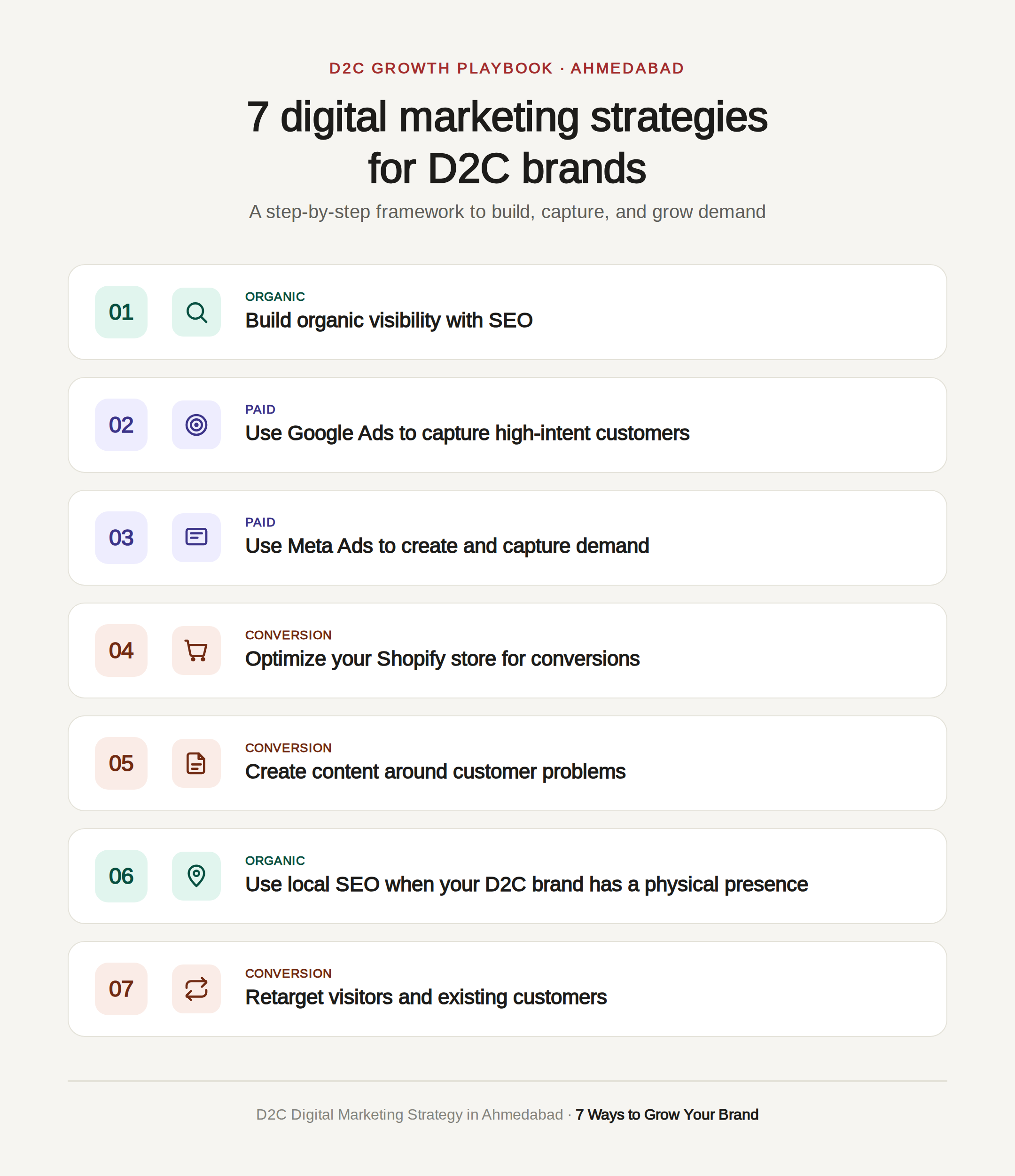
7 Digital Marketing Strategies for D2C Brands
1. Build Organic Visibility With SEO
SEO is the channel most D2C brands underinvest in, mainly because it doesn’t show results in week one. But for a brand planning to operate for years rather than one campaign cycle, organic search is usually the cheapest source of long-term traffic once it starts working.
For D2C brands, SEO isn’t only about ranking the homepage for a broad keyword. It includes:
- Optimizing category and product pages for the terms people actually search
- Publishing content that answers pre-purchase questions (“best X for Y”, “how to choose a X”)
- Fixing technical issues like slow load times and poor mobile experience that quietly suppress rankings
- Preparing content so it’s easy for AI-driven search tools to understand and cite, not just traditional search engines
If organic search isn’t part of your current plan, it’s worth looking at SEO and AI Search Optimization as a way to build a channel that doesn’t disappear the day you pause ad spend.
2. Use Google Ads to Capture High-Intent Customers
Google Ads works well for D2C brands because it captures people who are already looking to buy searching a product category, a competitor’s name, or a specific problem your product solves.
The mistake most D2C brands make with Google Ads is running broad match keywords with no negative keyword list, which burns budget on irrelevant clicks. A tighter setup Search campaigns on intent-based keywords, Shopping campaigns for product discovery, and Performance Max where the catalog is large enough to feed it usually performs better than one broad campaign trying to do everything.
Because Google Ads structure and bidding strategy directly affect cost per acquisition, many brands find it worth getting proper Google Ads management in place early, rather than fixing an inefficient account months later.
3. Use Meta Ads to Create and Capture Demand
Meta Ads (Facebook and Instagram) are usually the first paid channel D2C brands try, and for good reason the visual format suits most physical products, and the targeting options are strong for reaching new audiences.
Meta works best when treated as a demand-creation channel rather than a direct-response channel alone. That means running:
- Top-of-funnel creative aimed at cold audiences who’ve never heard of the brand
- Mid-funnel content addressing objections (price, quality, delivery time)
- Bottom-funnel retargeting ads for people who’ve already shown interest
Creative fatigue is the biggest recurring problem here the same three ads run for eight weeks straight will always show rising costs. Meta Ads generally sits under a brand’s broader performance marketing plan rather than being run in isolation from search and retargeting.
4. Optimize Your Shopify Store for Conversions
Most Ahmedabad D2C brands run on Shopify, and it’s common to see healthy traffic numbers sitting next to a disappointing conversion rate. A D2C conversion rate of 1-2% is typical for cold traffic; anything meaningfully below that usually points to friction on the site rather than a traffic quality problem.
Common conversion blockers include:
- Slow page load speed, especially on mobile
- Unclear shipping cost and delivery timeline information
- Checkout forms asking for more information than necessary
- Product pages missing size guides, ingredient lists, or usage instructions that reduce purchase hesitation
A/B testing product page layouts, simplifying checkout, and improving page speed usually move conversion rate more than any single ad campaign change. This is squarely a web design and conversion optimization exercise rather than a marketing spend problem.
5. Create Content Around Customer Problems
Most D2C purchase decisions start with a question, not a product search: “why does my skin break out after using X”, “how do I know my mattress size”, “is X safe for daily use”. Content built around these questions builds trust before someone ever visits a product page, and it supports the SEO work from strategy #1.
The content that performs best usually comes from customer support tickets, product reviews, and pre-sale questions because it answers what real buyers are actually asking, rather than what a brand assumes they want to know.
6. Use Local SEO When Your D2C Brand Has a Physical Presence
Many Ahmedabad D2C brands eventually open a store, a pop-up, or a warehouse pickup point. When that happens, local search becomes relevant even though the brand’s primary model is online.
This includes claiming and maintaining a well-optimized Google Business Profile, keeping location and hours accurate, and gathering genuine customer reviews. Google Business Profile optimization directly affects whether the brand shows up when someone searches for the product “near me” (Like: Digital marketing company in ahmedabad)
For brands with more than one physical location, or a mix of online and offline presence, Local SEO becomes a distinct workstream from the core national SEO strategy.
7. Retarget Visitors and Existing Customers
Most website visitors don’t buy on their first visit. Retargeting through Meta, Google Display, and email brings them back but this only works if there’s a clean flow of first-party data feeding it.
Practical retargeting layers for a D2C brand:
- Site visitors who didn’t add to cart
- Cart abandoners, usually the highest-converting retargeting segment
- Past customers who haven’t purchased in 60-90 days
- Email and WhatsApp flows triggered by specific actions (abandoned cart, post-purchase, win-back)
This is where the acquisition and retention sides of the funnel actually connect.
How a D2C Digital Marketing Funnel Works
A D2C marketing funnel isn’t a diagram to look pretty in a slide deck it’s a way of making sure every channel is doing a specific job.
Awareness
Social ads, influencer partnerships, and organic content introduce the brand to people who don’t yet know it exists. Success here is measured by reach and cost-efficient new-visitor traffic, not immediate sales.
Consideration
Search ads, SEO content, and product comparison pages meet people once they’re actively evaluating options. This stage is about answering objections clearly enough that the person moves toward a decision.
Conversion
The website itself product pages, pricing, checkout turns interest into a completed order. This is where conversion rate optimization has the most direct impact on revenue.
Retention
Email, WhatsApp, SMS, and loyalty programs turn a one-time buyer into a repeat customer. This stage is where LTV is built, and it’s the stage most D2C brands invest in the least relative to its returns.
SEO vs Paid Ads for D2C Brands
This isn’t really an either-or decision, but the two channels behave differently and it helps to know how.
Paid ads (Google and Meta) produce results immediately and can be turned on and off, but every rupee of traffic stops the moment spend stops. They’re well suited to launches, sales periods, and testing which products or messages resonate.
SEO takes longer to show results often three to six months for meaningful movement but it keeps producing traffic without ongoing spend per click. It compounds, particularly for brands that stay in the same category for years.
Most sustainable D2C growth strategies use paid ads to generate near-term revenue and customer data, while building SEO in parallel so the brand isn’t permanently dependent on rising ad costs.
Example D2C Digital Marketing Strategy for an Ahmedabad Brand
To make this concrete, here’s an illustrative example (not a real client result) of how a mid-sized Ahmedabad D2C skincare brand might structure its channel mix in a given month:
- 40% of budget on Meta Ads, split across cold prospecting and retargeting
- 25% on Google Ads, focused on branded search and category keywords
- Ongoing SEO content production, budgeted separately from paid spend
- Email and WhatsApp flows running continuously at near-zero incremental cost
- Monthly conversion rate optimization tests on the two highest-traffic product pages
If this brand had a blended CAC of ₹450 and an average order value of ₹900, the immediate ROAS would look thin on a single-purchase basis. The strategy only makes sense once repeat purchase rate and LTV are factored in which is exactly why retention can’t be treated as a separate, optional activity.
How to Measure D2C Digital Marketing Performance
The metrics that matter for a D2C brand go beyond clicks and impressions:
- CAC (Customer Acquisition Cost) : total marketing spend divided by new customers acquired, tracked by channel
- ROAS (Return on Ad Spend) : revenue generated per rupee spent on ads, useful for short-term channel comparison
- Conversion rate : the percentage of visitors who complete a purchase
- AOV (Average Order Value) : how much the average customer spends per order
- LTV (Lifetime Value) : total revenue expected from a customer over the relationship, not just the first order
None of these numbers mean much in isolation. A low CAC with a low repeat rate can be less profitable than a higher CAC with strong retention. Getting this visibility usually requires proper analytics and tracking set up across the website, ad platforms, and email/WhatsApp tools, so the numbers from each channel can actually be compared on the same basis.
Common D2C Digital Marketing Mistakes to Avoid
- Treating one channel as the entire strategy : usually Meta Ads, run in isolation until costs rise
- Ignoring SEO because it’s slow : and then having no organic channel to fall back on when ad costs increase
- Under-investing in retention : spending everything on new customer acquisition while repeat customers are left to email newsletters that rarely get opened
- Not fixing the website before scaling ads : sending more traffic to a low-converting site instead of improving conversion rate first
- No clear tracking setup : making decisions based on platform-reported numbers that don’t reconcile with actual revenue
Many of these overlap with broader common digital marketing mistakes for startups, which apply beyond the D2C model specifically.
Frequently Asked Questions
What is the best digital marketing strategy for a D2C brand in Ahmedabad?
There isn’t one channel that works alone. The strongest approach combines SEO and paid ads for acquisition, a conversion-optimized website, and retention marketing through email and WhatsApp built as one connected system rather than separate efforts.
How much should a D2C brand spend on digital marketing?
This depends heavily on margins, AOV, and category. Rather than fixing a percentage of revenue, it’s more useful to work backward from a target CAC that still leaves room for profit after product cost, shipping, and returns.
Is SEO worth it for a new D2C brand?
Yes, though it shouldn’t be the only channel in the first few months. New brands typically need paid ads for early traction while SEO content and technical work build up in parallel, since organic results take time to show.
How do I lower my D2C customer acquisition cost?
Improving conversion rate on the website often reduces effective CAC faster than trying to make ads cheaper, since the same traffic converts into more customers. Retargeting and retention also reduce blended CAC over time by increasing the value from each new customer acquired.
What’s a good conversion rate for a D2C website in Ahmedabad?
Most Shopify-based D2C stores see conversion rates between 1% and 3% depending on price point and category. Higher-consideration or higher-priced products tend to convert lower than impulse-purchase categories.
Final Thoughts
A working D2C digital marketing strategy isn’t about picking the trendiest channel it’s about making sure awareness, search intent, conversion, and retention are all pulling in the same direction. Brands that treat these as one system, rather than isolated campaigns, tend to see acquisition costs stabilize and repeat revenue grow, even as ad costs across the industry keep rising.
If you’re still figuring out the fundamentals before layering on channel-specific tactics, it’s worth starting with building a startup digital marketing strategy as a foundation, then applying the D2C-specific approaches covered here.

2 Comments